History of Art | Looking at Nature


Looking at Nature

Nature has been interpreted in many ways by artists throughout the ages.

Since prehistoric times, man has looked to nature for food, shelter, meaning, and inspiration.

Humans are the most powerful beings on this planet. But the force of nature can suddenly erase this power—think of the recent tsunami and hurricanes.

One of the first ways mankind tried to control nature was simply by drawing it. By making an image of nature, our ancestors believed they could capture its power. The first images of nature were most likely used to work magic: to provide protection against severe weather, for example, or conjure up strength and luck for hunting, or empower the female reproductive cycle.

In this lecture, we'll discuss the ways that artists throughout the ages have attempted to capture, analyze, and understand nature. As you'll discover, the story of art and nature begins in the caves of Western Europe and takes some surprising turns, from France to North Africa, to China, Renaissance Italy, Holland, England, and the United States. I'll also explore how the abstract art of the 20th century, a style not generally associated with nature, is powerfully influenced by nature.

In this lecture, you can expect to:

Learn how prehistoric artists represented nature.
Learn about nature in the art of ancient Greeks, Muslims, and Chinese.
Learn about changes in the representation of nature during the Renaissance.
Learn how artists in the Baroque period represented nature.
Learn how the Impressionists, post Impressionists, and Fauves represented nature.
Explore the relationship between nature and abstract art.


Most prehistoric art was created for a social purpose such as preparing for hunts or influencing natural events.


Prehistoric art is both intricate and abstract, not unlike the works of Picasso!


Even the stone architecture of prehistoric man had religious significance.


The Pharoahs distinguished themselves from lesser mortals by cultivating the arts of scripture, painting, sculpture, and architecture.


Though manmade, the pyramids blend naturally into the Egyptian landscape.


The interlocking geometric and floral patterns created by Islamic artists imitated the variety and repetition found in nature.


Chinese artists were required to study with masters before they could paint directly from nature.


Chinese artists strove to achieve harmony, rhythm, and balance in their compositions— emulating qualities they saw in nature.


Look at Chinese scrolls up close, and try to see the brush strokes.


During the Renaissance, painters, sculptors, and architects all began to address the question of perspective.


The center of the Renaissance was Florence in Italy.


Giotto's technique of chiaroscuro (from the Italian chiaro=light, oscuro=dark) influenced how artists portrayed the effects of light.


During the Renaissance, the arts and sciences were very interconnected. Artists incorporated advances of our understanding of nature in their work.


Linear perspective was a major technique in Renaissance art. Artists explored how to portray nature from different points of view and create the illusion of three-dimensional space.


Prehistoric Western Europe


Listen up, poets and writers: Before the written word, there was art. Art began in caves around 30,000 years ago, when our ancestors began to represent nature in their paintings of animals and human beings.

If you visit a cave with prehistoric art, you may be struck by how lifelike the paintings are, and also by how intricate and abstract the artwork is. (This means that two major styles of art, naturalism and abstraction, started about the same time, at the dawn of art! We will return to this point at the end of this lecture.)

Prehistory is a vast amount of time: roughly, from 30,000 BC to 2,000 BC. The amount of art produced in this large period of time is also vast, ranging from cave paintings to carved stone and bone sculptures, bead, stones, ivory, and shell jewelry, and enormous stone buildings called megaliths.

Our ancestors were busy in their depiction of nature. Let's find out how.

Cave Art

The first painted cave was discovered in Altamira in northern Spain, in 1879. Initially, no one believed the Altamira paintings dated back to prehistory. It wasn't until the early 1900s that historians determined they were created around 18,000 BC.

The ceilings at Altamira are covered with paintings of animals: bison, deer, and horses, as well as a boar. Peeking out from carefully chosen wall and ceiling undulations, the paintings seem three-dimensional and almost animated.
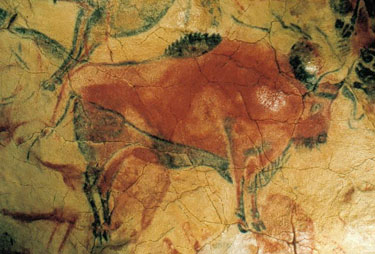
Cave painting at Altamira. This image represents a bison. Note the beautiful detail of the back hair and the skillful shadowing of the lower part of the animal.

The cave paintings of Lascaux in France (25,000-17,000 BC) are the largest and most famous ones discovered. Discovered by chance in 1940, they include about 2,000 images of a range of animal species—horses, bulls, and lions—and a few human stick figures painted with earth-colored pigments: brown, black, yellow, and red.

The artists created the figures by drawing an outline on the limestone walls, and filling it in with pigment. We assume these images were done in association with some kind of pre-hunt ritual because of the inaccessibility of the caves; no one would have crawled so far into the Earth's depths to simply decorate a wall. In 1963, the caves of Lascaux were closed to preserve them. Today, what you can see if you visit is a large replica that offers an idea of the immense scale of the originals.
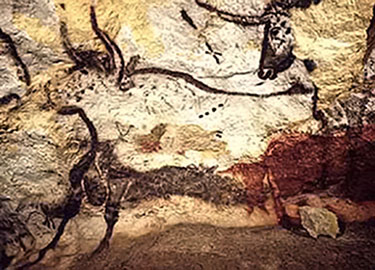
Cave painting at Lascaux. This painting captures the motion of a running bull. Unlike the bison, it has no back hair.

The most recent discovery of a cave painting was in France in 1994, and it was named Chauvet after one of the people who discovered it.

Chauvet is the world's oldest painted prehistoric cave, dating back to 30,000 BC. Rhinos are the dominant animal depicted amongst lions, mammoths, bears, horses, bison, reindeer, stags, a red panther, and an engraved owl. There are also positive/negative stencils of human hands, made by placing a hand on the wall and blowing pigment on it. The creatures are very naturalistic, with anatomical details that make it easy to recognize the animals that are represented.

Sculpture

The most famous sculpture of prehistoric times is the Venus of Willendorf (25,000-21,000 BC). It was done in the Paleolithic era and carved out of limestone. It is a sculpture in the round that fits in the palm of your hand. The figure depicts a pregnant woman with very large breasts and thighs and a huge stomach.

Rumor has it that the Venus of Willendorf was originally painted with red ochre, the sacred color of blood. The statue is associated with fertility rituals, and probably represented a fertility goddess. What makes the Venus of Willendorf so memorable is the sculptor's ability to simplify the shapes of a woman's body and yet retain her salient features.
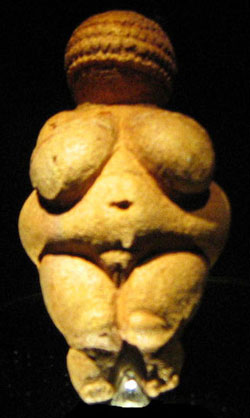
Venus of Willendor (c. 25,000 - 21,000 BC) The small size of the statue indicates that is was for personal use. The shape is abstract, simplified and reduced to a few cylindrical forms, but we can still recognize the female figure.

Megaliths

During the Neolithic period (6,000-2,000 BC), man shifted from hunting towards a farm-based civilization. This contributed to the development of megaliths, a monumental architecture made of big stones assembled without the use of mortar. Three types of structures were constructed—menhir, dolmen, and cromlech—each associated with religious themes.

Menhirs are slightly shaped single stones (monoliths), usually standing upright in the ground. They were erected individually, in groups or in rows. They have been interpreted as representing a phallic fertilizer of mother earth.

Dolmens are shelters or tombs with two or more upright stones for walls and a single giant block for a roof. Some interior walls are decorated with carvings and paintings.
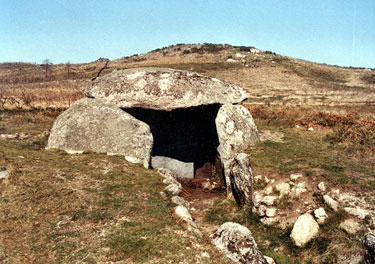
A dolmen in Portugal. The location of most dolmen seems strategic, as they always appear to be in harmony with the surroundings.

Cromlechs are thought to be sacred spaces. They consist of a group of menhirs forming a semi-circle or a circle. The most famous cromlech is Stonehenge in England (2800-1500 BC). This remarkable piece of architecture has been interpreted as a giant sundial used to predict seasonal changes and astronomical phenomena. Stonehenge has a purely geometrical design that has served many nature-related rituals.
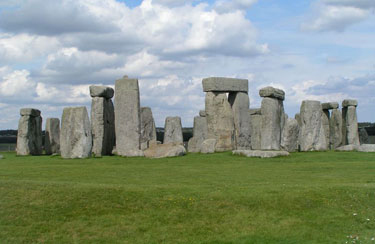
Stonehenge (c. 3000 BC) The Stonehenge cromlech is an impressive work. There are many theories about how it was constructed, but no firm conclusions. We should not underestimate the power of our ancestors.

Ancient Egyptian Art

Towards the end of the Neolithic period, there was a flurry of artistic activity in Egypt.

The Nile river valley was the home of one of the most powerful and long-lasting ancient civilizations. Beginning in approximately 3100 BC, the Pharaohs ruled Egypt with absolute control over the land and the people. Considered gods, they distinguished themselves from their human subjects by cultivating the arts of scripture, painting, sculpture, and architecture.

The most powerful enduring symbols of the power of the Pharoahs are the pyramids. The pyramids were constructed as burial places and as a conduit for the Pharaohs' passage into the afterlife. Though built by many thousands of men, the pyramids were so strategically placed that they seemed to blend into the desert landscape.
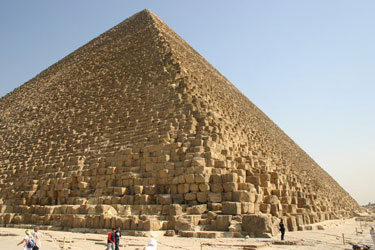
Kheops pyramid. The pyramids are a great example of ancient engineering. The pyramid is the most stable structure imaginable. It was built to last forever.

The design of the pyramids was purely geometrical. Though now stepped due to the passage of time, the sides of the pyramids were originally smooth and faced with polished limestone.

In the interior of the pyramids, chambers and tunnels were richly decorated with paintings and hieroglyphics—a writing system that used pictograms to denote objects, concepts, or sounds. Hieroglyphics combined a geometric regularity with a keen observation of nature, a characteristic that is common to all Egyptian art.

Pyramids of Giza. Giza is the most important Egyptian pyramid complex. It consists of the pyramids of Keops, Khefren, and Micerino, and the impressive Sphinx.

Islamic Design

Geometry is also a defining characteristic of Islamic art and design, which developed many centuries after the art of ancient Egypt, and was presented quite differently.

During the Middle Ages (600 - 1200 AD), the Moors, coming from Mauritania, invaded a great part of Spain and Portugal. They ruled over this territory until the XIII century, when the Christians reclaimed Granada, the last occupied province. The Moors were Muslims, and as they spread into the west, the Moors needed new mosques. Back then, the visual representation of human beings was prohibited by religion of Islam. Instead of feeling suppressed, however, Islamic artists let their imaginations play with geometrical patterns and floral forms.

The main architectural expression of Islam is the mosque. The most impressive mosque of this period is the Alhambra, in Granada. In the Alhambra, the interior courtyards and halls are richly decorated with the most subtle lacework ornamentations, known as arabesques. The domed chambers were built in an intricate geometrical pattern based on arches, and covered with elaborate stucco decorations and mosaics with golden backgrounds.
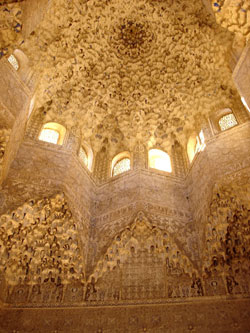
Alhambra. This highly decorated ceiling at Alhambra resembles the organic textures of ice stalactites or a coral reef.

Again, we see the attempt of artists to connect to nature. As the mind of the Moorish artist was directed away from the real world by religious beliefs, the artists then entered a dream-like world where they invented patterns based on complex line designs and rich color schemes.
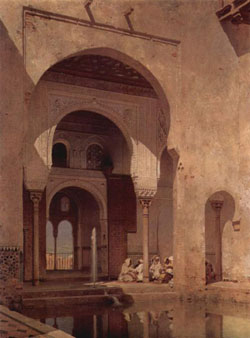
Alhambra (1886) - Adolf Seel. In this painting we can see how the main exterior arch at Alhambra repeats itself in the minor interior ones. The difference of scale alludes of the greatness of Allah compared to humanity.

If we look carefully at the designs at Alhambra, we can find nature's order within. Fractals, irregular or fragmented geometrical shapes, arranged in a pattern where even the smallest part is equal to the whole, is widely visible in Islamic design. But fractal theory is also used today to analyze natural shapes like clouds, coastlines, waves, and landscapes. Think about a cauliflower—even its smallest branch resembles the whole vegetable. Now look at the Alhambra designs. Even the smallest patch of stucco or mosaic gives an idea of the symmetry and rhythmic order of the whole building.
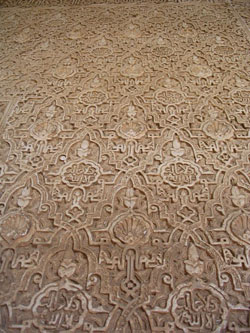
Arabesque at the Alhambra. Arabesques repeat themselves over and over. In this case, the purpose of the decoration is to induce meditative and trance states.

Chinese Art

During the same period, Chinese art also flourished. The Chinese have one of the longest and greatest artistic traditions in the world. Most early Chinese art reflected the power and mystery of nature. By the Song Dynasty (960-1279 AD), nature had become the prominent theme, emphasizing the balance between the two principal forces of nature, called yin and yang. Chinese landscape painters aimed for harmony, rhythm, and balance in their compositions.

To depict landscapes, Chinese artists used both black and colored inks on silk or paper scrolls. The most commonly used format was the hanging scroll. Instead of going out and copying the subject directly from nature, apprentices studied with great masters and looked to artistic masterpieces for inspiration.

Only when they had dominion over the brush and ink, would they travel and contemplate the beauty of nature, capturing the moods of the landscapes. Often they would write a poem and paint a picture on the same scroll.
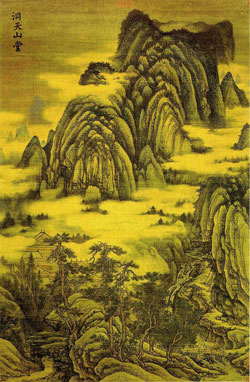
Hall in Mountains - Dong Yuan. In this work, your eye starts at the trees at the bottom of the composition, then ascends through the work, following the path the clouds make, until you reach the top of the mountain. The smoky clouds create an impression of altitude.

You can see tremendous precision in Chinese ink paintings and drawings. With a few brush strokes, the Chinese artists would exploit the effects of graceful curves to suggest movement, or depict mountain peaks, clouds, and trees with just a few lines and washes. Ma Yüan, Kao K'o-kung, and LiuTs'ai are amongst the masters of the Chinese ink technique.
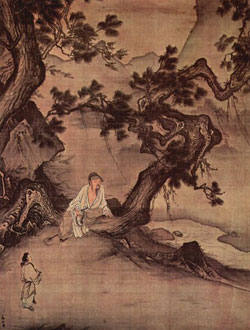
Wall scroll on silk (1246) - Ma Lin. Note the delicacy of the brush strokes that define both the tree branches and the men's beards. The richness of detail in the tree barks contrasts with the simplicity of the mountains in the background, which are defined only by color and a single line.

Illusionism in the Renaissance

As we learned in the first lecture, the Renaissance (1300-1600) was a major turning point in the history of art. We can almost say that modern painting in the West began during this period. Painting, sculpture, and architecture began to address the question of perspective for the first time.

Creating the illusion of depth (and therefore, the illusion of reality) became the main achievement of this period. The interest of artists shifted from telling a story with pictures as clearly and impressively as possible, to representing nature in the most faithful way. Artists started sketching studies they made from nature, which they later transferred into their pictures.
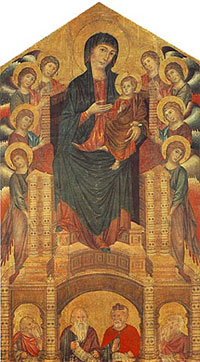
The Madonna in Majesty (1285-1286)- Cimabue. An early approach to linear perspective can be seen in this painting. Note how Cimabue arranges the angels around the Madonna; the further from the frontal plane, the higher they are in the composition.

To explore the emergence of illusionism in the Renaissance, I'd like to discuss specific artists who contributed to the period.

The Early Renaissance lasted for most of the fifteenth century (1390-1490) and featured such artists as Brunelleschi, Masaccio, Donatello, Piero Della Francesca, and Mantegna. The High Renaissance (1490-1527) introduced Titian and Giorgione, two artists whose work influenced landscape artists for years to come.

Let's meet some of those artists now!

Giotto

Giotto di Bondone (1267-1337), usually known just as Giotto, was the most important painter of the 1300s. His realistic style revolutionized painting in Europe and became a strong influence on the Renaissance masters of the 1400s.

At the time of Giotto's birth, painters were still following the medieval Byzantine style, portraying subjects in a flat, unrealistic way. Giotto changed all that by painting solid, natural-looking forms. Giotto was a master of lighting; he would illuminate one side of an object while painting the other side of it in shadow, to show how light shines on an object in nature.

Giotto mostly painted religious subjects. Among his most important works are frescoes at the Arena Chapel in Padua (1305), which depict the life of Jesus, and Madonna Enthroned (1310), done in tempera on wood at the Church of All Saints in Florence.

Filippo Brunelleschi

Later in the early Renaissance period came Filippo Brunelleschi (1377-1446), a pioneer in architecture. Like Giotto, Brunelleschi also worked in Florence, the birthplace of the Renaissance.

Brunelleschi's main achievement was the construction of the soaring dome of the Florence cathedral, which he completed by borrowing a construction technique used by the Romans. Brunelleschi is also credited with the invention of linear perspective. Brunelleschi was a painter and a sculptor, and among his circle of artist friends were Masaccio and Donatello.
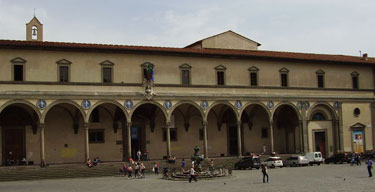
Foundling Children's Hospital, designed by Brunelleschi. Brunelleschi's architecture is characterized by the use of supporting arches. These kinds of structures sparked the creation of the linear perspective theory.

Masaccio

Born Tommaso Cassa, the artist Masaccio (1401-1428) earned his nickname, which means "clumsy Thomas," for his absentmindedness. Masaccio was the first painter to include linear perspective in his work, using it in the fresco Holy Trinity with the Virgin, St. John, and donors (1425-8). He used the effects of light and atmosphere to impart a new realism in his work.

Using strong modeling and lifelike poses, Masaccio created figures that have a lifelike solidity on painted surfaces that appear to be a continuation of the actual world. The frescoes at the Brancacci chapel are his most important work. In those frescoes, he perfected Giotto's technique of chiaroscuro (from the Italian chiaro=light, oscuro=dark). His figures were influenced by Donatello's sculptures.
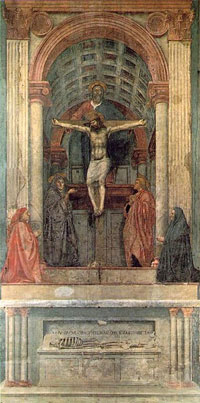
Trinity (1427) - Masaccio. Depth in this painting is obtained not only by the linear perspective on the dome over Christ, but also by the many fine gradiations of light and shade.

Donatello

Donatello (1386-1466) was a master of all the techniques and materials of sculpture. Like his friend Masaccio, he wanted to replace the gentle refinement of his gothic predecessors with a new and vigorous observation of nature. His sculptures were full of life. In fact, they are convincingly realistic because Donatello had a deep knowledge of anatomy.

The Medici Family commissioned Donatello to create his bronze David (1430-1440). It was the first nearly life-sized, naturalistic nude sculpture. The relaxed pose of Donatello's David is influenced by classical statues.
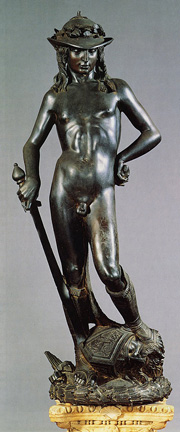
David (1430-1440) - Donatello. This typical pose of classical sculpture is called contraposto: the weight of the body rests on one foot, while the other is graciously bent, giving the figure an S-like curve.

Other famous works by Donatello include Saint George (1415-1416), a carved marble, and Gattamelata (1443-1453), a bronze equestrian monument.
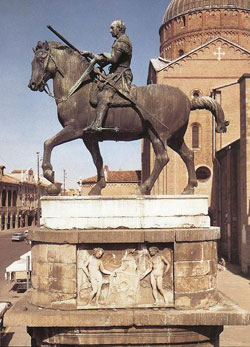
Gattamelata (1443) - Donatello. Donatello achieved a true representation of nature in this sculpture. The proportions of horse and human are correct, and equestrian grace is depicted by the lifted leg and the vigorous tail.

Piero Della Francesca

The painter Piero Della Francesca (1415-1492) favored the representation of graceful figures in uncluttered, open spaces, and his use of lighting techniques far surpassed his contemporaries.

Della Francesca used light not only to define the contours of shapes, but also to create a sense of distance and depth. His work exhibits careful shading in the distance of his pictures and incorporates shadows cast by the figures. Amongst his masterpieces are The Flagellation of Christ (1453), Constantine's Dream (1460), and Battista Sforza and Federico da Montefeltro (1475).
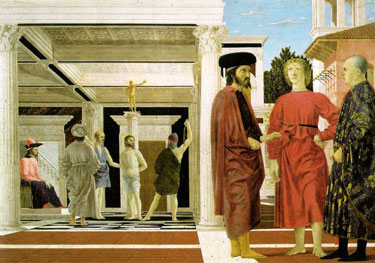
The Flagellation (c. 1460) - Piero Della Francesca. In this painting, the figures in the frontal plane (first plane) are brightly colored and well defined, while the figures in the background (third plane) are opaque and not clear. The middle or second plane is empty except for two columns, one bright and one shadowed.

Andrea Mantegna

Unlike Della Francesca, Andrea Mantegna (1431-1506) painted sharply outlined, sculpture-like figures. Mantegna's figures were precisely detailed and the surfaces of his characters seemed to be marble. He obtained dramatic effects through perspective and by showing the human figure from below.

Mantegna was a genius who established himself as a master when he was seventeen. His patrons were the Gonzaga Family from Mantua. His masterpieces include a painted dome in the Gonzaga's Ducal Palace (1474), where he depicts a round opening to the sky. Through the opening, you can see several characters engaged in conversation looking down on the audience, accompanied by a little angel who is preparing to drop an apple.
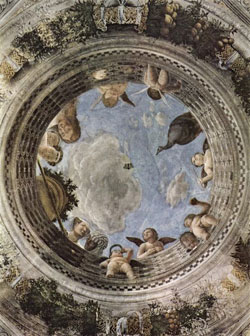
Ducal Palace dome (1473) - Andrea Mantegna. The illusion created in this dome painting is due to the creation of several different planes. In the first plane we see the hanging vegetation, in the second, the soaring architecture, in the third, the characters looking down upon us, and in the last, the open sky.

Other works by Mantegna include St. Sebastian (1480) and St. James Led to Execution (1455).
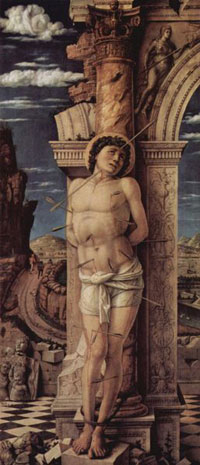
St. Sebastian (1480) - Andrea Mantegna. Mantegna's control over linear perspective can be seen in the checkered floor and the background scenery here. Note how St. Sebastian in the first plane is fully illuminated, while everything behind him is opaque.

Titian and Giorgione

Tiziano Vecellio (1487-1576), better known as Titian, was a Venetian painter. Unlike the early Renaissance artists, he had an apparent disinterest in anatomy and used warm colors deepened by many layers of glaze. He covered a wide range of subject matter: portraits, religious, mythological, and allegorical scenes.

Titian's biggest achievement was to continue to develop a concept pioneered by his contemporary Giorgione (1478-1510), who died too young to fully develop it. Giorgione, and later Titian, didn't draw places and people then later arrange them in space. Instead, they thought of nature, the earth, the trees, light, air, clouds and atmosphere, and human beings with their cities and architecture, as one. Each of these elements had the same importance in their compositions.

Giorgione's oil on canvas The Tempest (1508) and Titian's Pesaro Madonna (1519-1526) clearly blend many aspects of nature in a cohesive whole.
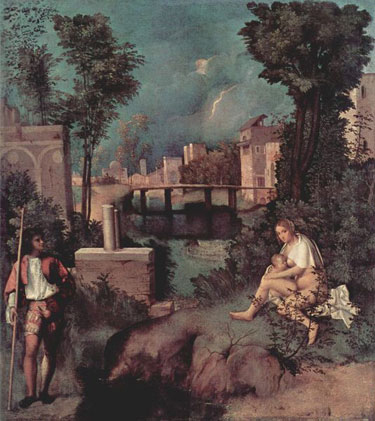
The Tempest (c. 1508) - Giorgione. In this painting, Giorgione uses the river to divide the picture plane two four areas. Background and foreground represent city and nature; left and right represent male and female.

Venus of Urbino (1538) is another of Titian's masterpieces. It shows a young naked woman lying on a mattress in a very sensual manner. This pose, with its naturalistic representation of the body, has influenced artists for centuries.
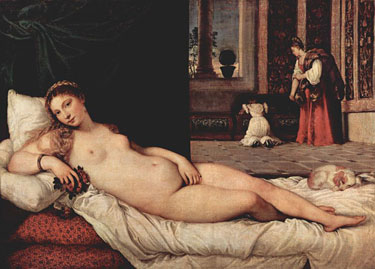
Venus of Urbino (1538) - Titian. The picture plane is strongly divided in two. Venus lies in the front protected by a black velvet curtain, while in the back of the room, a different scene takes place, almost as if it were a different painting within a painting.

In paintings like Bachanal (1518) and Rape of Europa (1559-1562), Titian was able to maintain a general harmony despite the audacity of his compositions.


Dutch artists of the 17th century paid great attention to portraying nature through landscapes and seascapes.


The sky itself was an important subject in Baroque painting. Artists began to explore its changing moods and the effects of light.


Baroque painters were intrigued by the contrast between wilderness and the landscape that had been domesticated by man (farmland).


Claude Monet's outdoor scenes explore the effects of light and color on the eye.


Post-Impressionists such as Cézanne focused on blocks of color and fundamental shapes in their work.


Abstraction is the process of analyzing something and reduced it into its essential parts.


Though some abstract artwork has no relation to nature specifically, it can evoke emotions similar to those you feel when enjoying nature.


By using collage, Cubists incorporated three-dimensional materials into a two-dimensional picture plane.


As the abstract art movement of the 20th century progressed, art became progressively more abstract—further removed from the reality it represented.


After World War II, the center of the art community moved to New York City in the US.


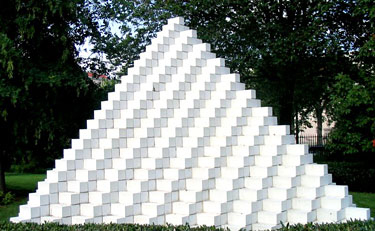
Compare Sol Lewitt's pyramid piece with the Egyptian ones! Often, abstract art echoes the way that the ancients portrayed nature.
 

Baroque Interests
Landscapes, Seascapes, and Still Lifes

Like Titian and Giorgione before them, a number of Baroque artists in the 17th century began to incorporate nature into their pictures at the same level of importance as human characters.

One of the most famous of these artists is Frenchman Claude Lorrain (1600-1682). Lorrain was one of the first artists to master the realistic representation of nature. He is well known for the detail in his trees, such as the ones in his oil on canvas painting Landscape with Sacrifice to Apollo (1662-1663). Have you heard of English country gardens? Many rich Englishmen designed their gardens following Lorrain's model of nature.

The Dutch Influence

Dutch artists in the 17th century were among the first to discover the beauty of the sky. They realized that they didn't need a dramatic or striking scene to make their pictures interesting. They simply represented a piece of the world (the world overhead) as it appeared to them.

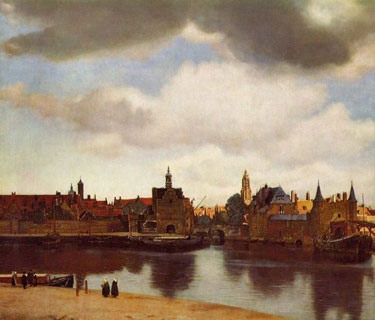
My favorite Dutch artist is Jan Vermeer (1632-1675). He mainly painted interior scenes that we'll study in later lectures, but one of his greatest masterpieces is an impressive landscape called View of the Delft (1660-1661). Both sky and river seem to glow in this painting. Vermeer uses shifting light and shadows to create a calm balance in the picture.

View of the Delft (1660-1661) - Jan Vermeer. Balance in this painting is obtained by allowing more space to the sky and clouds, than to the scenery on the ground. If the town occupied more of the canvas, the heavy and dark house blocks would keep the viewer's eye in the bottom part of the painting.

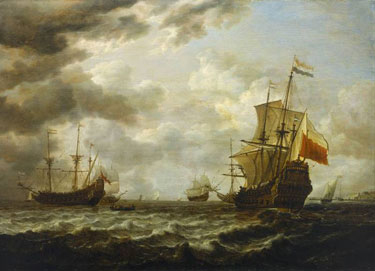
Dutch painter Simon de Vlieger (1601-1653) was a specialist in seascapes. In his painting Dutch Man of War and Various Vessels in a Breeze (1640-1645), he conveys the atmosphere of the sea and leads our eyes into the hazy distance.

Jacob van Ruisdael (1628-1682), on the other hand, was a specialist in landscapes. He could express so much of his own feelings and moods through how they were reflected in nature. Among his oil on canvas paintings we can count Extensive Landscape with Ruins (1660), A Pool Surrounded by Trees (1665-1670), and his most famous painting, The Jewish Cemetery (1655-60).

The Brederode off Hellevoetsluis - Simon de Vlieger. The choppy water of the waves echo the chunky dark clouds heavy with rain. Note how de Vlieger balances the comosition by darkening the upper left corner and the lower right one.

Still life paintings are close-ups of objects. The objects can be natural, such as fruits and vegetables, or manufactured, like rifles and bottles. The arrangement of the chosen objects can mean many things, from the bounty of nature to its decay and the passing of time.

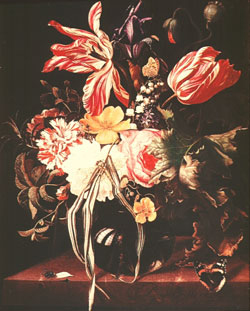
Among the Barqoue artists who specialized in still lifes are Maria van Oosterwyck (1630-1693), Willem Kalf (1619-1693), Willem Claesz, Jan de Heem (1606-1684), and Rachel Ruysch (1664-1750). In contrast to the macrocosmic views of Dutch landscape, the still life reflects the microcosm; a small world within a world.

Vase of Tulips, Rose, and Other Flowers with Insects (1669) - Maria van Oosterwijk. Van Oosterwijk depicts different stages of nature in this oil painting. The flowers in the still life range from blooming to fully open to dry and dead. The bright color of the arrangement contrasts with the dark background.

Later Landscapes

The atmosphere created by the Dutch painters influenced a later generation of artists—the Romantics. Romanticism swept through Western Europe and the United States in the late 18th and early 19th centuries. In Germany, Caspar David Friedrich (1744-1840) used poetic landscapes to capture the romantic nostalgia of the past. In his oil artwork Two Men Contemplating the Moon (1819), we can see two men in silhouette surrounded by animated branches reaching toward them. They seem lost in nature.

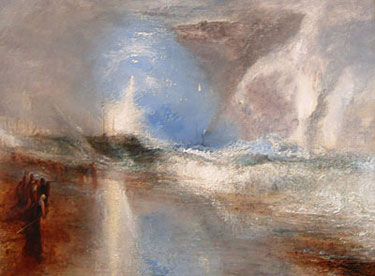
In England, the two greatest Romantic landscape painters, John Constable (1776-1837) and Joseph Mallord William Turner (1775-1851), approached their subjects quite differently. Constable's images are clear and focused on the English country life, while Turner's works, forms, and outlines seem to dissolve into shimmering mist, steam, or smoke, or into the intense light of bright sky or water.

My favorite Turner painting is The Slave Ship (1840). Its contrasting colors give an apocalyptic quality to the picture. It depicts a slave ship in the middle of a typhoon—with dead or dying slaves being cast into the sea.

Rockets and Blue Lights (1840) - Joseph Mallord William Turner. Note the atmospheric quality obtained by the blurry forms and the washed brush strokes. Turner invites us into a tunnel of light that takes us to a blast of white and a dark that resembles an eye in form.

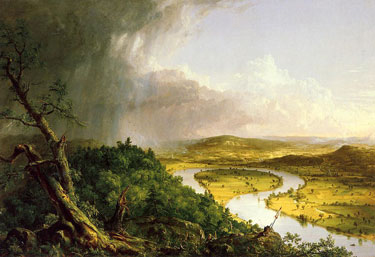
In America, Thomas Cole (1801-1848) was inspired by different parts of the countryside. In his painting The Oxbow (1836) Cole makes a contrast between nature's wilderness and the domesticity of the human world, represented by a farm. A thunderstorm divides the picture plane in two, on one side, the dark wild, on the other, the clear farmland.

The Oxbow (1836) - Thomas Cole. A clear curve divides the picture plane in two. Rain is depicted with vigorous downward brush strokes.

Art for the Art's Sake
Impressionism

Continuing our tour of the 19th century, we meet the French artist Edouard Manet (1832-1883) and his followers, known as the Impressionists.

The Impressionists broke tradition by using subject matter in unexpected ways. They also revolutionized the rendering of color. They discovered that if we look at nature in the open, we do not see individually-colored objects but rather a bright medley of tints and tones that blend together in our eyes and minds.

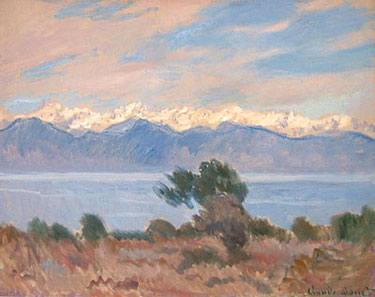
The works of Impressionist Claude Monet (1840-1926) were a spontaneous response to outdoor scenes or events. Monet was the first artist to let his initial impressions of outdoor views stand as complete works. In 1874, Monet exhibited a landscape called Impression: Sunrise in Paris. This patchily-textured oil on canvas painting gave the name to a whole movement, Impressionism. Impressionists studied the natural effects of light and color on surfaces.

The Bay of Angels Seen from Cape d'Antibes - Claude Monet. Notice the zig-zag quality of the composition in this painting. The brush strokes used for the clouds and mountains contrast those used in the sea and grass. Small brush strokes indicate the speed of Monet's painting technique.

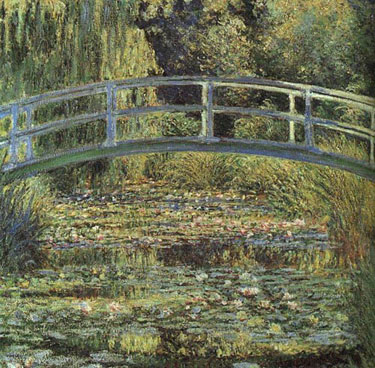
Monet's later work, like the painting Water Lily Pond (1904), reflects his concern with the direct observation of nature. In this oil painting, nature itself is his model. He defines the pond's surface with vertical brushstrokes of greens, blues, yellows, and purples. The lily foliage is transformed into relatively formless patches of colors. Without the lily pads and the edge of the pond, there would be no recognizable objects at all. As a result, instead of accepting a canvas as a convincing representation of reality, the viewer is invited to relate to the technique and medium in order to experience the picture.

Water Lily Pond (1899) - Claude Monet. Monet's achievement is a study of light. Check out the luminosity that contours the bridge railing, the background trees, and the different levels of the pond.

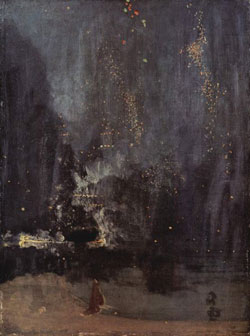
In London, an American artist was also causing a revolt. James Abbott McNeil Whistler (1834-1903) is famous for a trial that also involved the English art critic and artist John Ruskin (1819-1900). Ruskin criticized one of Whistler's most abstract paintings, Nocturne in Black and Gold, The Falling Rocket (1874). Ruskin declared that Whistler had flung "a pot of paint in the public's face." Whistler sued Ruskin for libel and defended his formal theories with the famous phrase "art for the art's sake"... Whistler won the case but got less than a penny in damages!

Night in Black and Gold, The Falling Rocket - (1874-1875) James Abbot McNeil Whistler. Whistler leaves this picture open to interpretation. The brown stain in the lower part may be a human figure standing by a lake, the golden dots may be a reflection of the city lights, and the downward brush strokes may be seen as pouring rain.

Post-Impressionism

Paul Cézanne (1839-1906) was a Post-Impressionist (meaning he came after Impressionism). Cézanne, more than any artist before him, transformed paint into a visible structure.

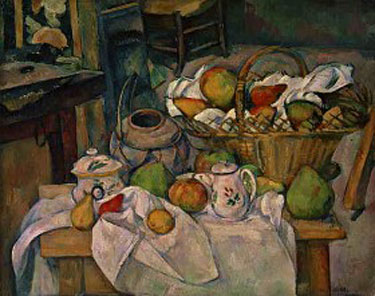
Unlike the Impressionists, Cézanne didn't emphasize the effects of light. He wanted to capture color as an individual element that could be used to build up forms and structures. To him, every brushstroke was like a building block. He believed that all forms in nature are based on fundamental shapes such as the cone, the sphere, and the cylinder. Amongst his most famous paintings are Still Life with Apples (1875-1877) and the landscape Mont Sainte-Victoire (1900).

Still Life with Fruit Basket (1888-1890) - Paul Cézanne. The free use of perspective gives us the impression that things are falling out of the picture plane.

Fauvism

The Fauves (1905-1907) were a group of French artists who tried to express as directly as possible the vividness and excitement of nature. Their style emphasized a simplified view of the world through intense color and rapid, vigorous brushstrokes. The word "fauves" means "wild beasts" in French. A critic gave the artists this name because the colors and movement in the pictures reminded him of the jungle.

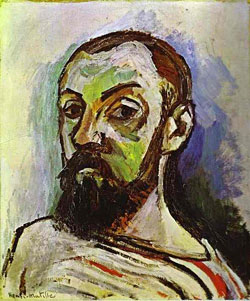
The leading Fauve artist was Henri Matisse (1896-1954). Other members of the group included Andre Derain, Raoul Dufy, and Maurice de Vlaminck.

Self-Portrait in a Striped T-Shirt (1960) - Henri Matisse. Matisse incorporates greens and blues to color his skin, yellows to contour his eyes, and oranges and red to color his hair and beard.

Matisse's oil painting Woman with the Hat (1905) portrayed his wife as a color construction, an approach he learned from the impressionists and post-impressionists. Throughout the picture plane, shading, modeling, and perspective are subordinate to color, which finally creates the features.

Abstraction

The term abstraction is used to define the process (or the result) of analyzing and simplifying observed reality into its essential parts, such as an idea or a set of geometric shapes. Abstraction has been the most distinctive and consistent feature of modern art.

In the following part of the lecture, we will study different approaches to abstraction in the 20th century, and examine how abstraction relates to the artist's study of nature.

Cubism

The Cubists, who flourished in France between 1907 and 1914, represented figures and objects by geometrical forms. Cubism took Cezanne's new spatial organization into account, as well as African, Oceanic, and Iberian tribal art.

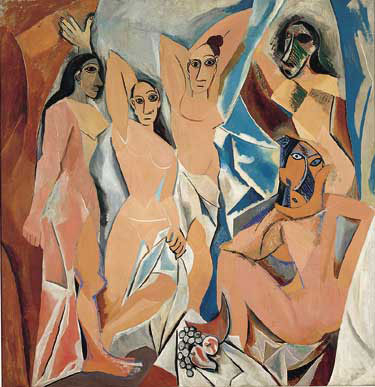
One of the founders of Cubism was Pablo Picasso (1881-1973). Picasso's painting Demoiselles d'Avignon (1907) was a landmark in the development of modern abstraction. It is a composition of five nude women and a still life. The human bodies are angular and disproportionate, and the faces of the women are based on African masks. The Demoiselles cannot be read as an image of the external world. The world contained within the picture is similar to nature, but constructed on very different principles.

Demoiselles d'Avignon - Pablo Picasso. Picasso combines frontal, back, and side points of view of the same subjects. Though he constructs the figures in geometric ways, we can still recognize the female bodies and a small arrangement of fruits in the lower middle of the painting.

Georges Braque (1882-1963) was another Cubist who worked closely with Picasso. The two artists explored different mediums and produced a large number of collages, incorporating different materials into the picture plane. Braque's Newspaper, Bottle, Packet of Tobacco (1914) actually included real objects in the canvas. These scraps of paper played a double role: they represented part of the image, and they represented the artists as outsiders in the art world.

Cubist paintings are traditionally described in terms of analytic cubism and synthetic cubism. Analytic cubism is the style that emerged about 1910 and suggests the way artists broke down, and then reassembled observed forms. Synthetic cubism refers to the style of 1912 and later, in which artists tried to synthesize (combine) imaginative elements into new representational structures.

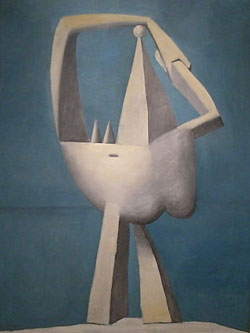
Nude Standing By The Sea (1929) - Pablo Picasso. The stark simplicity of this work (this is a nude woman standing by the sea) is representative of Picasso's later Cubist work.

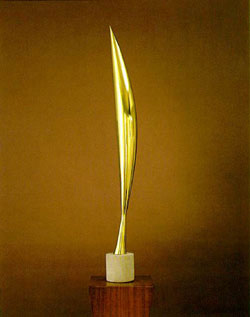
Constantin Brancusi (1876-1957) was a Romanian sculptor who shared the Cubists' interest in ethnographic art. He was concerned with the formal simplicity and coherence of tribal carvings. His stone sculpture The Kiss (1908) depicts a couple embracing. Brancusi contrasted flesh and stone as a metaphor of the duality of guilt and desire. In 1910, he began to produce non-representational pieces in marble or metal. In his famous Bird In Space (1928), he captured the essence of flight: upward movement and a sense of freedom.

Bird in Space (1923) - Constantin Brancusi. Brancusi's elaborate abstraction is a pre-cursor of Minimalist art, in which a single or a few elements represent the whole piece. In this case, a flying bird is represented by a single curve in space. (Think about the Nike swoosh!)

Suprematism and Constructivism

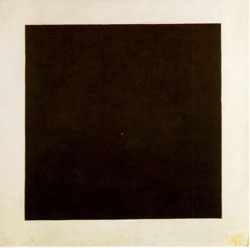
Suprematism started in Russia with Kasimir Malevich (1878-1935) and was a natural development from Cubism, reducing painting to its essential elements: color, line, and shape. Malevich's suprematist paintings consist of a monochrome square on a white background. On White on White (1918), a white square floats on a white background. The two surfaces are only distinguishable through slight differences in tint and the direction of the brush strokes. Suprematism is the first purely abstract style.

Black Square (1913) - Kasimir Malevich. Malevich's work is an analysis of color and form that distills art to its purest visual elements.

Suprematism faded in the 1920s, and Russian art fragmented into other movements. One of these was constructivism, led by Vladimir Tatlin and the brothers Naum Gabo and Antoine Pevsner. The Constructivists called their work "constructions," arguing that their works were four-dimensional as they implied motion, and therefore time. They experimented early in kinetic sculpture, creating a scientific "culture of machines."

De Stijl or Neo-Plasticism

Similar to the minimal style of suprematism was an entirely non-representational style called neo-plasticism pioneered by Piet Mondrian (1872-1944). Mondrian's imagery was reduced to flat rectangles of color bordered by black edges. With his strict compositions, he influenced modern architecture and commercial design.

In Composition with Red, Blue, and Yellow (1937), Mondrian restricts his design to vertical and horizontals and the three primary colors (red, blue, and yellow) plus black and white, eliminating any possibility of representation. Yet in Broadway Boogie Woogie (1942-1943), there is some degree of relationship with observed reality.

Bauhaus

Another development in 20th century art was the emergence of graphic design, which evolved and flourished quickly, thanks to the Bauhaus school. The Bauhaus was founded in 1919 in Weimar, Germany, by a community of designers, architects, and artists. It was led by Walter Gropius (1883-1969) with an aim to improve the aesthetic quality of manufactured goods, and the design of architecture. The Bauhaus artists created a simple, unornamented style to be applied across all fields. Its influence is still felt in contemporary design.

Some of the artists involved with the Bauhaus were the Russian painter Vasilly Kandinsky and the French architect Le Courbusier. After moving the Bauhaus to the town of Dessau in 1925, the Nazis finally closed the school in 1932.

Abstract Expressionism

After the Second World War, the center of the art community shifted to New York City. The work produced in this period of time (1942-1957) was a direct response to the historical circumstances, namely the end of two world wars. The painting style that prevailed in this period was known as abstract expressionism, and it was more a philosophical attitude than a particular style.

We can divide abstract expressionism in two branches: action painting (which we'll study in a later lecture) and color field painting. Two of the most influential immigrant artists were Hans Hofmann (1880-1966) and Josef Albers (1888-1976), both from Germany. They taught at the Art Students League in New York and at Black Mountain College in North Carolina, respectively. Both artists explored color and geometry in their paintings.

Other Europeans who were key at creating a transition from Europe to America were Vasilly Kandinsky (1866-1944) and Arshille Gorky (1904-1948).

Color field painters stained the canvas with thin, translucent color washes. The color washes were initially done using oil or ink, but acrylic quickly became the favorite material. The imagery is calm and inwardly directed, and is capable of evoking a meditative, even spiritual, response.

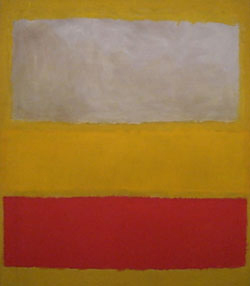
The most important color field painter is Mark Rothko (1903-1970). His paintings are rectangles balanced in fields of color. In No. 15 (1957), two black-green rectangles occupy an intense, vibrant blue. By muting the colors and blurring the edges of the rectangles, Rothko softened the potential contrast between them. He also muted the observer's attention to the process of painting by virtually eliminating the presence of the artist's hand.

No.13 (1958) - Mark Rothko. The hand of the painter has disappeared, and what is left is just pure color.

Other color field artists are Helen Frankenthaler, Barnett Newman, and Frank Stella. I wanted to include color field painting in this lecture because when I look at this style painting, I feel like I am looking at a landscape. Though there is no literal reference to nature, I enter a kind of trancelike rapture, very similar to the sensation I feel when I see a sunset or a shimmering ocean surface. These paintings share the quality of a beautiful and rarified landscape.

Op Art

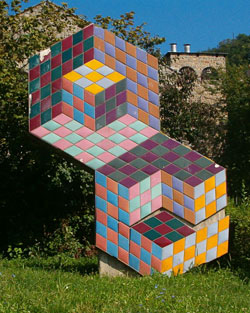
The term op art stands for "optical art." Op art flourished during the 1960s and was devoted primarily to optical illusions. It was also strictly non-representational. Op artists produced kinetic effects using arrangement of color, lines, shapes and the combination of these elements. They make the picture plane dazzle or flicker with movement.

An outdoor Op Art piece by Victor Vasarely. Our eye is fooled into believing there is depth, where there is none. Vasarely creates the illusion of depth by choosing exactly where to shade, and where to illuminate. This piece can be found in Pecs, Hungary.

Amongst the important op artists we can count the English artist Bridget Riley (born 1931), and a group of Venezuelan artists who included Alejandro Otero (1921-1997), Jesus Rafael Soto (born 1923), and Carlos Cruz-Diez (born 1923). These artists did paintings, sculptures, and installations.

Minimalism

In the 1960s, a group of artists called minimalists began working with primary structures (cubes, cylinders, and so on). Their works are direct statements of solid geometric form: sculptures with an impersonal character, with no narrative or reference to nature, and no content beyond the medium itself. American minimalists include Dan Flavin, Donald Judd, Sol Lewitt, and Robert Ryman.

Four-Sided Pyramid (1997) - Sol LeWitt. Sol Lewitt combines two basic geometric shapes to create this sculpture. The cubes are arranged to form a pyramid, very much how the ancient Egyptians did it. It stands in the National Gallery of Art in Washington, D.C.

Land Art

Land art, also called environmental art or earth art, comprises works that have an impact (usually temporary) on the environment. Robert Smithson (1938-1973) sculpted his works out of the landscape, using rocks, earth, water, and other natural materials. He built Spiral Jetty (1970) in the Great Salt Lake in Utah. It consists of a 1,500-foot coil spiraling into the lake. When it was built, you could walk your way to the center of the spiral. This work is degradable and is gradually succumbing to the natural elements.

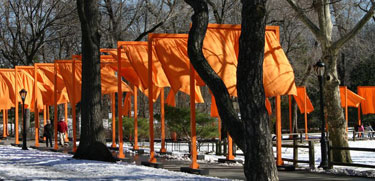
Another approach to shaping the environment can be seen in the work of Christo and Jeanne-Claude. These artists wrap up buildings or sections of landscape. Surrounded Islands (1983) consist of a series of islands off the coast of Florida enclosed by pink polypropylene.

The Gates (2005) - Christo. The Gates were created specifically for Central Park in NYC. An estimated 4 million visitors had the opportunity to walk through paths made of bright orange structures, creating a whole new way of experiencing a city landmark.

Artists have walked a long way since prehistory's megaliths to the earth works of our time. However, nature has been a constant throughout art history as a theme or subject, an inspiration, a background, as something to distort or completely neglect, or even as the material itself, as seen in land art.


Learn how the ancient Egyptians, Greeks, and Romans portrayed the human body.
Explore how pre-Renaissance African and Japanese artists represented the human body.
Learn how Renaissance and Baroque artists approached representing the human body.
Explore how 19th and 20th century artists have portrayed the human body in sculpture and performance art.
 

Discussion
Share your thoughts on art history with your fellow students.

Exercise
Research and analyze art that focuses on nature and critique abstract work.