It
may sound odd to talk about the framing of
an image if you think the word framing only refers to the outside border of a shot, like
a picture frame. In film and video it is much more than that. Framing represents
a certain point
of view and it actively defines the image for the viewer in many ways.
To
talk about framing, we have to define first what a shot is.
A shot is a continuous action or image on the screen that appears
to be
the result of a single uninterrupted operation of the camera. This action
of course involves framing: deciding the area or the field
of view that
the camera will record.
The
frame selects a slice of the world to show to us. It implies a position from
which the material is being viewed. This position will have an angle,
a level, a certain height, and a certain distance from the subject.
Camera
Angle
The
angle of
framing with respect to what is shot is theoretically infinite, since there
are an infinite number of points in the space in which to place the camera.
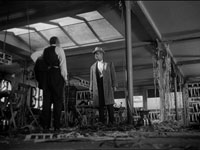
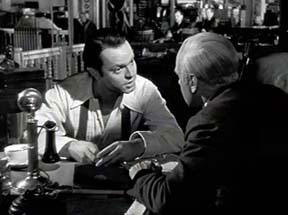
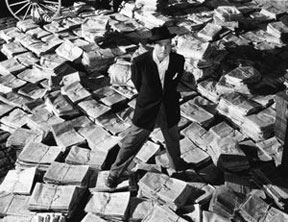
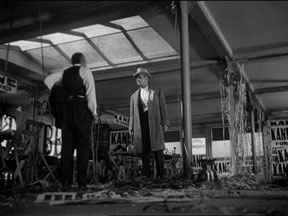
But three camera angles are particularly important: the straight-on
angle (which is the most common), the high
angle, and the low angle.
 |
Straight-on
angle shot |
 |
High angle
shot
|
 |
| Low angle shot |
We
can also distinguish the degree to which the framing is level,
in other words, the sense of gravity governing
the material that is being shot. If the framing is level, the horizontal
edges of the frame will be parallel to the horizon of the shot. But it
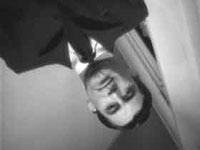
doesn't have to be always like that—it can also be used creatively,
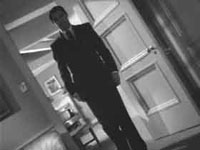
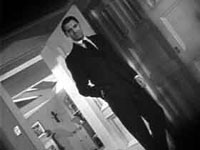
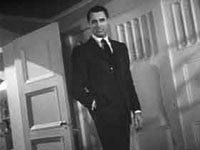
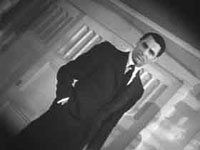
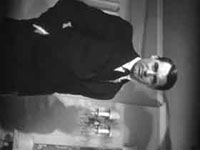
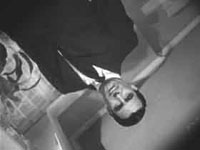
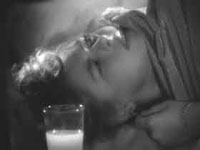
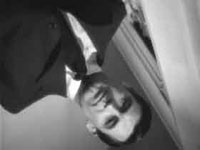
like in the following sequence where a hung-over Ingrid Bergman gets
a slanted view of secret agent Cary Grant in Alfred Hitchcock's film Notorious.
You'll notice
in the sequence below that as Cary Grant approaches, the image starts to spiral. Hitchcock
often tried to show us what his characters were seeing. Here he uses
an elaborately disjointed shot to express Bergman's physical state and mental confusion.
Camera
Height
Sometimes
it is important to specify the sense that the framing gives us of
being stationed at a certain height.
Camera angle is obviously related to the height of the camera in
a sense, but camera height is not simply a matter of
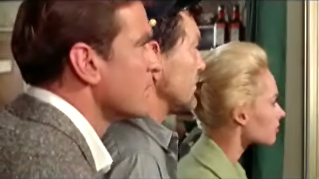
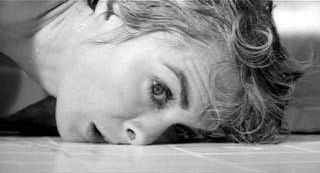
angle. We can shoot at a low height with a straight-on angle like
in the
last shot of the shower sequence in Hitchcock's Psycho.
 |
A
straight-on angle shot from almost floor level |
Camera
Distance
Framing
also supplies a sense of distance from the subject. In the following shot categories, the standard measure is the scale of the human body.
A
long shot [LS] is any shot
taken at a considerable distance from the subject. It includes
the whole body
of a person in relation to the environment.
An establishing shot [EST] is a
long shot that defines the basic location where the subsequent events
will
take place. This shot is also called
wide shot [WS] because the field
of view is very wide.
Depending on the distance it is taken from,
an establishing shot can also be categorized into medium
long shot [MLS] or extreme long
shot [ELS]—like
a bird's eye view of a place or a city.
Let's examine the following examples
of camera distance from Eyes Wide Shut (Stanley Kubrick, 1999):
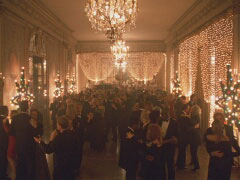 |
Establishing Shot
[EST]. Establishes the ball that the characters will be attending. |
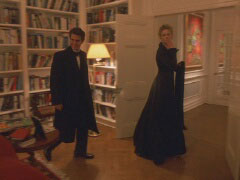 |
Long Shot [LS]. Shows the characters entering the building, allowing the viewer to see their sumptuous surroundings and clothes. |
The medium shot [MS] usually frames the human body from the waist up. This is also sometimes called plain américain, given its recurrence in several Hollywood films where it starts from the knees up. A medium shot usually frames the body from the waist or the knees up. This kind of framing permits a good balance between the subject and its surroundings; gestures and expressions become more visible in it.
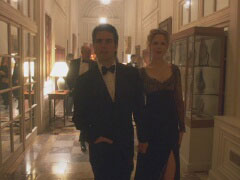 |
Medium Shot [MS]. Shows the experience of the characters walking into the event by depicting their reactions as they walk down the hallway into a crowded room. |
The medium close-up [MCU] frames the body from the chest up. A close up [CU] could be a head and shoulders shot or closer, to emphasize facial expression, the details of a gesture, or a significant object. The extreme close up [ECU] singles out a portion of the face (eyes or lips) to isolate detail.
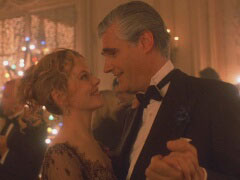 |
Medium Close-Up [MCU]. Provides a close-up of a conversation, showing facial expressions. |
 |
|
Close-Up [CU]. Provides a very tight close-up of a more intimate exchange! |
Case
Study: Hobart
How do a director's choices in framing—angle, height, and distance—work in a short film context? The
following clip is an excerpt from the silent film Hobart (1999) by Caspar Stracke. Watch closely how the scene is broken down by different approaches to framing, and
make a list of all framing/camera angles.
The scene is deliberately exaggerated, as you see two protagonists literally
pouring out emotions. We chose this scene because in this context it
might be easier to make the connection between framing/camera angle
and the intention of the filmmakers. This short film is based on the surrealist
story "L'Écume des jours (Foam of the Days)" by Boris
Vian. A water lilly has grown in the lungs of Chloe. She is about to
suffocate, her partner Colin desperately tries to save her. Doctors
arrive.
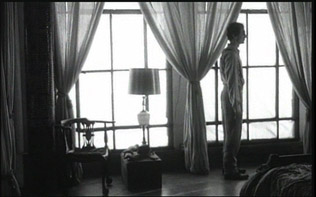 |
Hobart
(1999). Click the image to watch the clip in a new window. |
To develop your understanding of framing,
we would like you to make a shot by shot list of this short scene. List each
camera angle by its name and think about the filmmaker's intention. Which shots really work well in your
opinion (in terms of framing) and which ones maybe work less well?



 Learn about the
different kinds of framing used by directors.
Learn about the
different kinds of framing used by directors.