What Are the Reasons to Rebrand?
You've already spent a lot of time in this course considering how copy can be targeted to different audiences, even when advertising a single product. We'll now apply that thinking to revising a full brand campaign.
 |
| This vintage 1950s-era McDonald's billboard shows "Speedee," the first McDonald's mascot, touting the "Speedee Service System" as a major hallmark of the brand. (Image source: Trance Field) |
There are numerous reasons that companies revise their brands: to stay relevant, boost sales, attract different audiences, stay in sync with product line changes, or simply because it's time for a new look. As a copywriter/designer, honing in on why the brand revision is necessary is the first step to understanding how the brand can have better appeal and how advertising copy can help achieve that.
In the video below, Deborah Wahl, the Chief Marketing Officer for McDonald's, expresses that the company has not only rebranded its line of products with a more lovin' angle, but that it's undergone a full change of philosophy that permeates its customer (and employee) relations, moving "from 'Billions served,' to 'Billions heard.'"
Some reasons behind the latest McDonald's brand revision
Wahl's video gives a little bit of insight into McDonald's reasons for rebranding, besides the clear drop in profits, and besides the company's desire to express more love.
As Wahl states, "because of the growing importance of farm-to-table, we're going to make sure that our customers know that every Egg McMuffin is made with a freshly cracked egg."
In Wahl's acknowledging of the farm-to-table movement, she shows that McDonald's believes it can capitalize on the movement in order to keep or attract an audience that's interested in real food and better health.
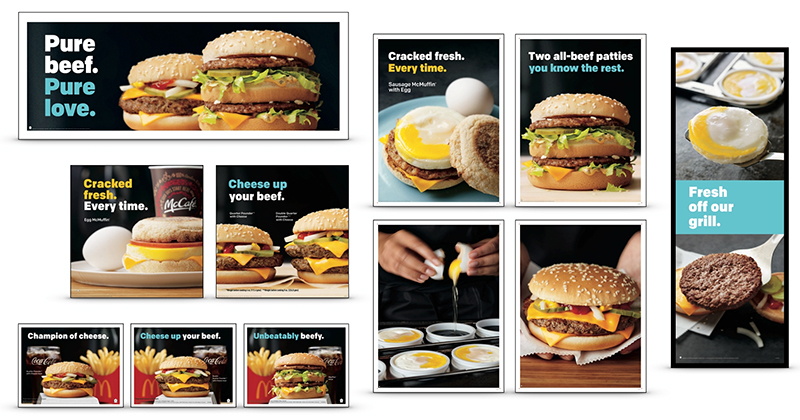
And why not? With the right copy and a revised company approach, a rebranding should be able to achieve that. These images of some of the new McDonald's ads follow Wahl's line of thinking:
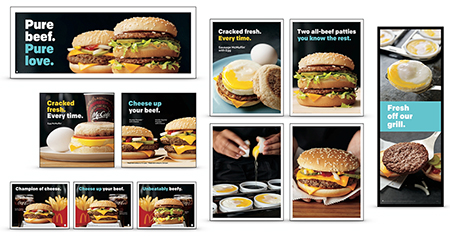 |
Reflecting the real food movement
Click here or on the image for larger view. (Image source: McDonald's) |
Taking a look at them in detail, you'll notice how some of the ads, like those which say "Cracked fresh. Every time" and "Fresh off our grill," promote the freshness of the product, while the top-left image, which states, "Pure beef. Pure love," marries both the farm-to-table and the lovin' aspects of the brand campaign.
The image of the Big Mac that states, "Two all-beef patties / you know the rest," not only stresses the real food aspect of the campaign, but harkens to the McDonald's ad from 1974 that was set to a jingle, listing out the "Two all-beef patties, special sauce, lettuce, cheese, pickles, onions, on a sesame seed bun" that are included in the sandwich.
Interestingly, this ad relies so strongly on the familiarity of the past campaign that it doesn't even mention the product name. The ad also suggests, however, that it's not necessary to offer the rest of the jingle, because what's now important to its audience is that the patties are "all-beef."
Clearly, McDonald's also is rushing to counteract effects from scandals such as the use of contaminated and expired meat in its China processing plants, and the general and recently popular claims that its food doesn't decay, but in case any one is eating while reading this lesson, we won't go there.
What Mediums Best Fit the Audience?
Thinking about the different types of copy that short text, single page ads, and multiple page ads span, it's clear that a brand redesign can demand attention to an awful lot of ad mediums.
While a change in a brand's message may need to reach the same audience via the same ad channels previously used, a change in the target audience for a brand may require a change in what platforms it uses to advertise.
AT&T's recent hiring of VICE Media to develop a platform of ads that capture a younger generation's reliance on mobile technology is a move that proclaims that the types of media that appeal to millennials are the kinds that should be used to advertise to them.
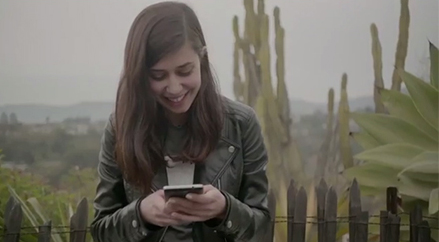 |
Millennials on mobiles (Image source: AT&T). |
VICE's take is to document via video what youth themselves have to say about what the technology means in their lives.
Considering the other venues for and types of ad copy that we've discussed throughout this course, you can imagine that this rebranding campaign—focused around branded video ads like those we saw in Lecture Three—also might include things like:
 |
|
 |
| |
Hashtags for use on social media -
SEO titles for online ads that will drive Web users searching for things like new phone features to specific AT&T products -
In-app ads that appear when users are on their cell phones
A series of guerilla marketing video projections An advergame product or other interactive type of multimedia ad
|
|
 |
|
 |
It may be obvious, but a crucial step to effectively revise a brand is to determine what types of ads, and thus ad copy, will best reach the audience a company is seeking.
How Can Copy Convey a Rebrand?
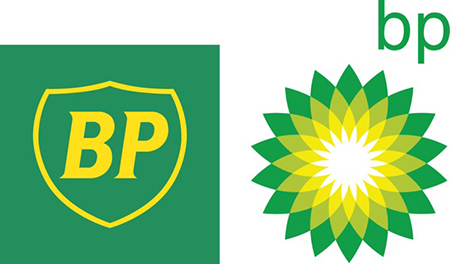
We've already alluded to BP's rebranding from "British Petroleum" to "Beyond Petroleum," beginning with its name and extending to all of its marketing and advertising collateral—from single-page ads to storefronts, television, and the Web.
Now, let's look at how some of BP's specific rebranding efforts entice the audience through ad copy.
 |
Pushing beyond its image. Click here or on the image for a larger view. (Image source: Grist) |
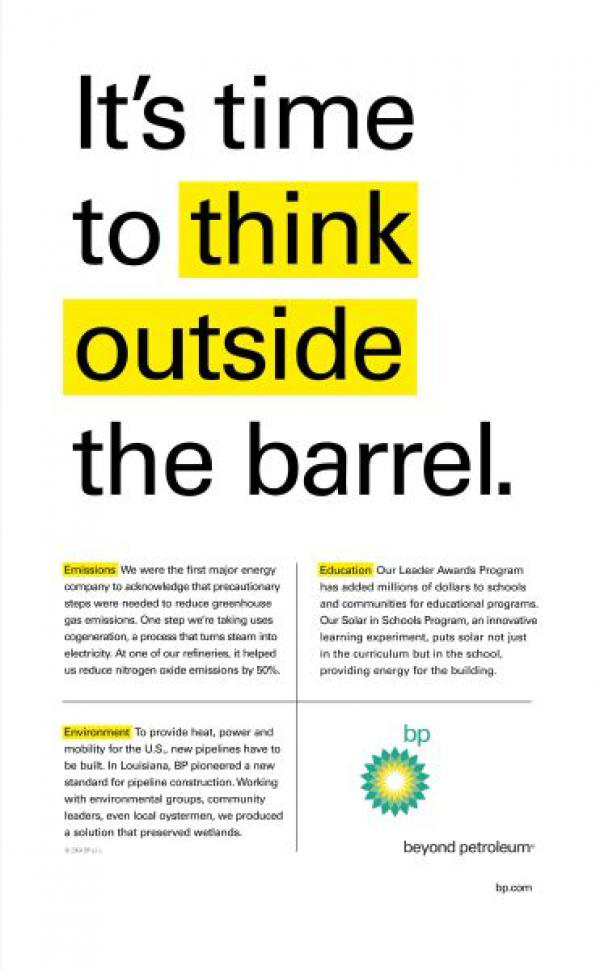
The smaller copy in the above ad for BP stresses the company's efforts toward reducing emissions, preserving wetlands in the midst of oil pipe construction, and teaching students about solar energy through programs that BP helps implement in schools.
Thus, the command to "think outside the barrel" not only summarizes what BP reveals about its own actions, but pushes the audience to think outside the barrel about BP. The copy so much as exclaims, "Hey! We're different than what we used to be."
In the two BP ads below, comparisons made in the phrases, "A cleaner turnpike," and "A better pipeline," also suggest difference, in the form of improvement:
 |
| One of the ways rebranding can convey change is by stating it. Click here or on the image for a larger version. (Image source: Coloribus) |
Plus, the phrase "It's a start" that's repeated in each of these ads indicates to the audience that they should expect even more improvements from BP in the future.
You can see how, in these rebranding efforts from both BP and McDonald's, it's important for the company to convey that it's now different, almost like acknowledging mistakes that led to a breakup, and trying to prove that it now will do better and pay more attention to the audience's needs.
Rebranding to Reach New Audiences
We also saw in prior lectures how the Domino brand of sugar has gone through some revisions. SWM Creative, a boutique advertising firm from New York, developed a brand campaign for Domino sugar that emphasizes what's emotionally sweet about the product.
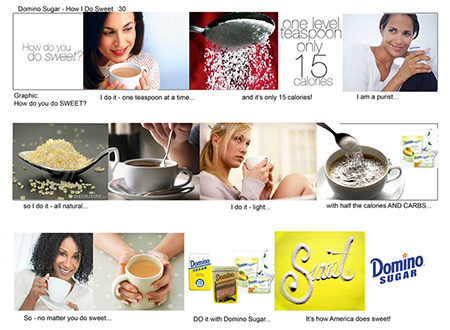 |
Appealing to individual tastes, as well as feelings. Click here or on the image for a larger version. (Image source: SWM Creative) |
The variable slogan, "It's how I do sweet," appears in this and other ad mockups as "It's how America does sweet," "That's how we do sweet," and "It's the new way to do sweet."
The stress in these ads on adding sweetness, whether it's literally adding a little bit of sweetness to coffee, "one teaspoon at a time," or doing things like baking with family and friends that make someone feel good, is a stress on comfort and happiness.
Let's think about how this brand campaign is different from prior ones for Domino sugar, and what makes it a brand revision.
Although Domino hasn't changed much about its logo presentation—still using a similarly slanted font for the word "Domino," which is positioned on an angle (okay, so there is a stylized star above the letter "i" now)—this doesn't mean that the company hasn't rebranded. Consider, for instance, how McDonald's has kept the same golden arches through various rebrandings, for reasons of recognition and loyalty.
What the ads appeal to will give you insight into what the overall rebranding is about. Remember that as a copywriter/designer, you want to first think about what the reasons are for the company to rebrand.
In the vintage ad campaign that we looked at in Lecture One, represented above, although "Sweeten it with Domino" was used as part of the company tagline, the emphasis in these ads is not on the emotional fulfillment achieved through using Domino sugar.
Being smart, on the other hand, does seem to be an emphasis. The woman who is offering the caloric information of sugar compared to an egg seems vastly knowledgeable, also on the topic of the Domino "'Energy Lift.'"
This gives us a bit of insight into things like how women were changing their roles and statuses in American society, and what may have been important to an audience undergoing the transition from solely being housewives to also being workers.
In this ad mockup from SWM Creative, using a variable tagline based on "It's how I do sweet," the same concern about calories that's in the vintage ad is handled very differently.
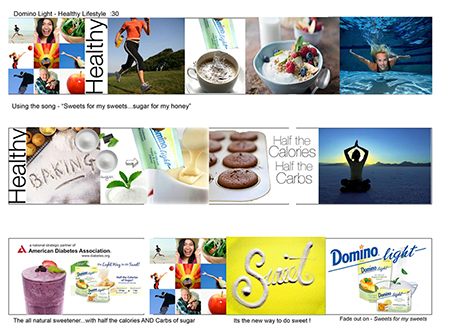 |
Smart and emotional eating, in an ad
Click here or on the image for a larger version. (Image source: SWM Creative) |
Not only does the ad include a more current dietary concern about carbohydrates, it employs images that express a more well-rounded, fulfilling, and enjoyable lifestyle, which thankfully includes being able to eat chocolate cupcakes.
The "new way to do sweet" is thus tailored to an audience that may feel they're lacking enough time to enjoy life, but also sees the need for healthy behaviors and eating. They're smart and emotional, being women who can have it all.
In SWM Creative's pitch for this branding campaign, in fact, they wrote: "We believe if we can inspire a 'feel good' connection to Domino Sugar—then we are on the right path...feeling smart and connected to family and friends is what it’s all about—because that feels great." Note how the references in this text to "smart" and "'feel good'" are translated straight from the pitch to the copy.
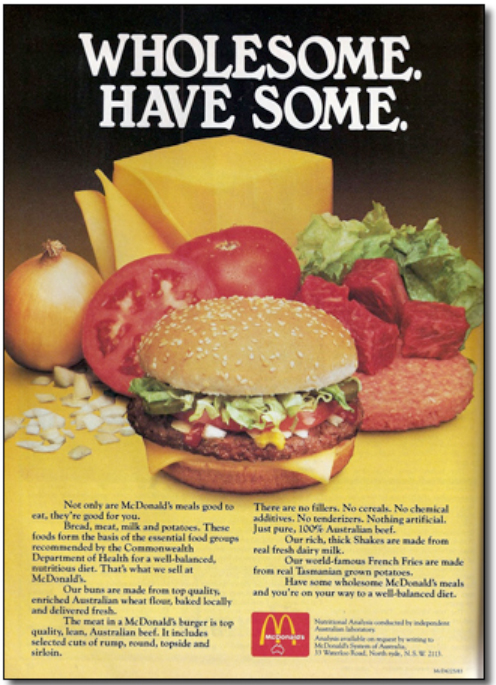
Getting back to how McDonald's handles rebranding, this single page vintage McDonald's ad below, from the Commonwealth of Australia, advertises the company's use of locally produced Australian beef and wheat flour, as well as Tasmanian potatoes.
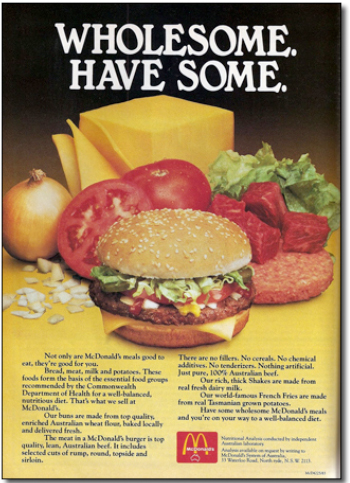 |
Branding beef (and onions, lettuce, tomatoes, cheese, and wheat) wholesome
Click here or on the image for larger view. (Image Source: PavaBlog). |
It's odd to read this vintage Australian ad and realize that some of the sales points revealed in the copy, like whether ingredients are produced locally, are those that current day American audiences might also preference. Generally, this helps show how writing copy for revised brand campaigns is very similar to just writing for specific audiences.
This copy is obviously not for a contemporary audience, however, whether in Australia or America. "Bread, meat, milk and potatoes" as the essential food groups? Okay, so no one nowadays would really think that what goes on a McDonald's burger (plus the fries) makes a balanced meal, but somehow this audience is not so concerned about vegetables.
In the meantime, it seems like a similar era McDonald's ad in America, below, indicates that what audiences were concerned about was costs, and that the low price point at McDonald's would make it "your kind of place."
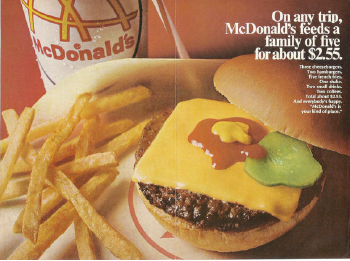 |
Your wallet's kind of place. Click here or on the image for larger view. (Image Source: Vintage Adarama) |
It's pretty clear that this American ad campaign is about money, and about selling McDonald's as a smart option for consumers who care about their spending.
Throughout this course, you've been developing skills to allow you to target audiences with your copy, and you've now seen that revising a brand campaign requires essentially these same skills, with just a few extra considerations.
As we've discussed, first, make sure to consider the reasons for why a rebranding campaign is necessary. Is there a large audience that the brand is ignoring? Does the brand need to correct a slight to its current audience? (Or worse, alter both its policies and audience perception after an oil spill or a discovery of the use of child labor?)
Second, evaluate what kind of ad mediums will be the most effective for reaching a new audience or a new segment of the audience, if there is a change in who the audience is.





 Explore the motivations of a rebranding campaign.