You've already seen some short copy examples in Lecture One. In print ads, brands like Domino Sugar or Dove may command an audience through direct, straightforward, and sometimes snappy taglines like "Sweeten it with Domino" and "One-quarter cleansing cream—Dove creams your skin while you wash."
Besides being used in traditional print forums like magazine ads, such short ad copy might appear on 2D surfaces like billboards, store window ads, sandwich boards, and business cards.
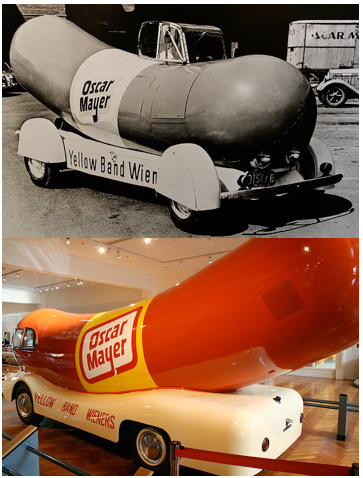 |
| Yellow Band Wieners at home or on the road; top image from the Wisconsin Historical Museum and bottom by Gregory Varnum. |
3D objects are also prime spots for short copy, with giveaway items like drink coasters, stickers, buttons, hats, and t-shirts providing creative opportunities for ad design and placement.
One of my favorite memories from childhood was riding in the car with my mother and seeing a car shaped like a high-top sneaker on the other side of the highway.
Although I didn't realize it at the time, it was likely a traveling advertisement for sneakers, similar to the Oscar Meyer Weiner hot-dog-shaped cars with license plates that read "Bologna", "Yummy," and "Big Bun", which you can still see on the road today as moving advertisements for both the hot dogs and the brand of deli products.
The Web also serves as an ideal place for short copy that can be quickly comprehended. Banner ads, animated ads, pop-up ads, and targeted social media ads are just some examples of ad formats welcoming short text.
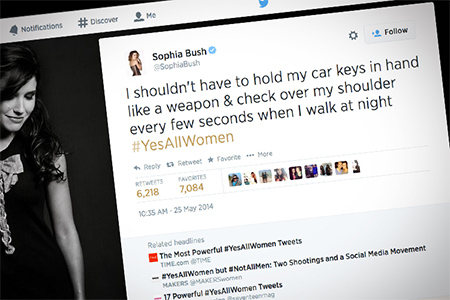 |
| Twitter hashtags are a form of short copy, and they've proven very effective and popular for both advertising and social justice campaigns. |
Moreover, as new online platforms develop, even more avenues for persuasion via short copy appear. The spread of social media campaigns serve as a reminder that a few words on their own or accompanied by an image can convey a powerful message in support of a cause, service, product, or brand.
Short copy is also prevalent in video and audio formats. Television and radio ads incorporate taglines and short statements with the same frequency as in other types of media. A 15- or 30-second TV or radio spot often will hinge on short taglines that help sell the product or service.
For example, Egyptian TV ads for Panda brand cheese primarily rely on the tagline "Never Say No to Panda" in connection with a costume-Panda-bear having a violent outburst if his name brand of cheese isn't purchased.
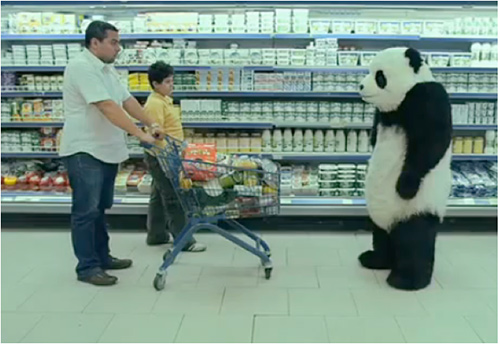 |
| Intimidation as persuasion |
Multimedia formats using short copy that may be less familiar but still powerful tools of persuasion include guerrilla-marketing video projections, cell phone applications, interactive multimedia, or hypermedia.
For example, a fundraiser for the Salvation Army in Chicago and Toronto used guerrilla-marketing video projections that visually altered when viewers donated money via text message, effectively illustrating the benefits of using surprise, interactivity, and clever, direct persuasion in an ad.
Though we've briefly discussed some types of short copy such as taglines and hashtags, looking more specifically at the various types can help illuminate the best practices in writing short copy overall, as well as what discerns the types from one another both stylistically and persuasively.
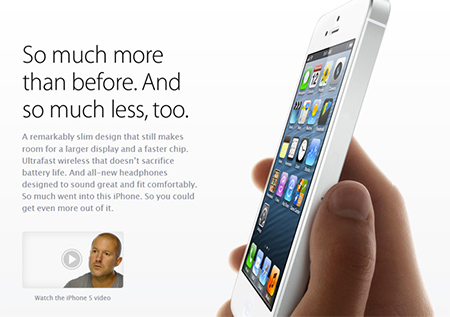 |
| Apple is known for its seductive, clipped sentence style of short copy. |
Never assume that writing short copy will be easy just because it's short, as there are added pressures to engaging an audience through just a few chosen words.
Let's now discuss some of the ways that short copy does its thing.
Product Names, Brand Names, and Titles
Before the rise of online shopping, back when catalog shopping was popular, I always thought a fun job would be to come up with color names for a clothing company like J. Crew. It was easy to fall for the enticement of names like "aubergine" and "stormy heather." After all, just as color attracts an audience, so does language, even in its simplest form of naming and titling.
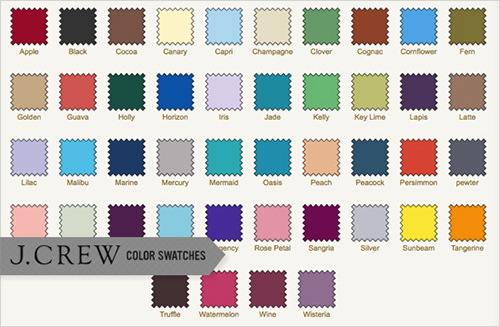 |
| J. Crew's color swatch titles are triumphs of short copy. Horizon blue and sangria purple, anyone? |
As a versatile designer, you may find yourself coining product and brand names, if, for instance, you're working for a client who needs you to develop a complete ad or marketing package for a product line.
Re-branding or re-designing an advertising approach for a client sometimes can involve the re-naming of products and brands, as well. For example, the BP energy and gas company, British Petroleum, underwent a re-branding campaign in 2000 that aimed to present the company as a greener choice.
BP marketed itself anew as the more aware "beyond petroleum" and acknowledged, in a simple two-word moniker, both the idea of petroleum and the idea of moving beyond it, by stressing the company's alternative energy investments.
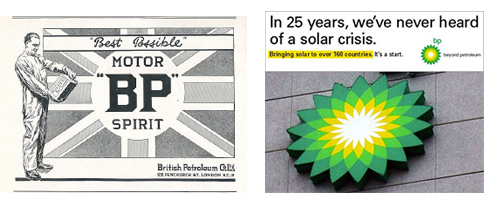 |
| BP: coming up with the "Best Possible" use for its acronym through re-brandings. |
Though not the first BP re-branding campaign, "beyond petroleum" is successful for several reasons. Thinking about the copywriting principles that we reviewed in Lecture One, you can see how "beyond petroleum" considers both the sales message and audience, positioning itself as being aware of environmental issues and thus appealing to a younger audience that's concerned with global warming and resource use.
Along with the newly designed logo with the BP colors that riffs off of natural images like the sun, leaves, and a flower pattern, "beyond petroleum" coheres well with the audience's emotional response to the logo components, inspiring attention, interest, desire, and action (AIDA).
Even critics of BP have used this logo and moniker re-design to comment ironically on the oil company's role in the 2010 Gulf oil spill, in which the Deepwater Horizon oil rig exploded, through alterations of the ad image that draw on the concerns of its audience.
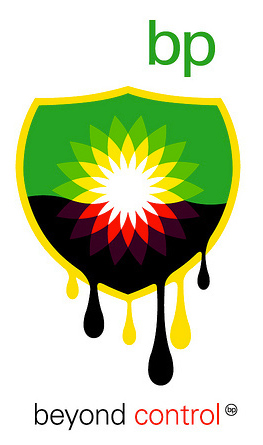 |
| BP's acronym flexibility sometimes works against it! |
Naming products or categories of products is also a task you may find yourself involved in when designing catalogs or websites that demand new ways of organizing product.
On the Cotton Monster website, the handmade stuffed animals in the brand's line are thematized according to monster types and other stuffed animal types: Land Monsters, Sea Monsters, Space Monsters, the Von Katz Family, and Watchful Eyes. It's easy to see how the monster product names are closely connected to and thus recall the brand name, as well as how the playfulness of the other two stuffed animal types also reflect the brand.
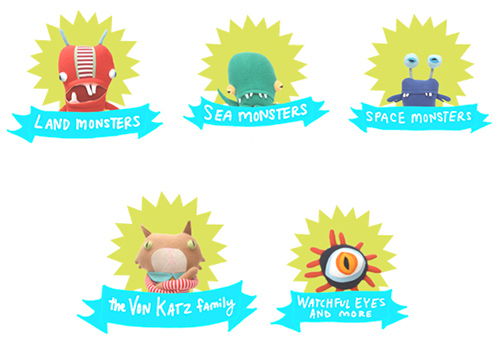 |
Types of Cotton Monsters that help boost the brand |
Categorizing the products based off of the brand name in this way also helps build brand loyalty: you can imagine a child wanting to have a land monster, sea monster, and space monster for her growing stuffed monster collection, and a parent finding this an easy way to please a child who loves a certain stuffed toy.
You also may find yourself writing title copy for things as diverse as workshops, panel discussions, video ads, and the marketing ad titles that specify an ad's key words and appear at the tops of web pages, such as Search Engine Optimization (SEO) titles.
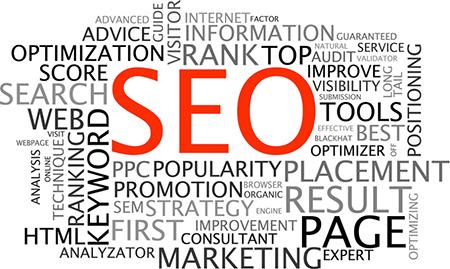 |
Writing short copy for SEO is a field unto itself! (Image credit: Express Writers) |
When working for a small client that doesn't have its own marketing or creative department to title things, this scenario is even more likely. Titles are paramount, as they can determine the amount of exposure that an ad or specific ad content receives.
The primary goal of SEO titles, for example, is to drive an audience to an ad via the online search function, and so it's crucial to use key words in the ad title that capture content succinctly while being in tune with the audience you wish to attract. If you want to tap into an audience that seeks out natural products, for instance, as long as the product holds up to the claim, "natural" is an essential key word.
Headlines, Headings, and Subheads
The trend of overly-emotional headlines in various online venues, such as Upworthy and Buzzfeed, that I noted earlier, portrays a somewhat narrowed view of what kind of copy gets an audience to engage.
Though these kinds of headlines can produce click-throughs, they can also severely turn off a large segment of an audience. And as noted, they often mislead the audience by promising a content focus that isn't delivered upon.
Above all, headlines, headings, and subheads must capture the gist of copy that follows. This requires writing that is clear and succinct, that uses summarizing skills as well as strategies to make your language more active and direct.
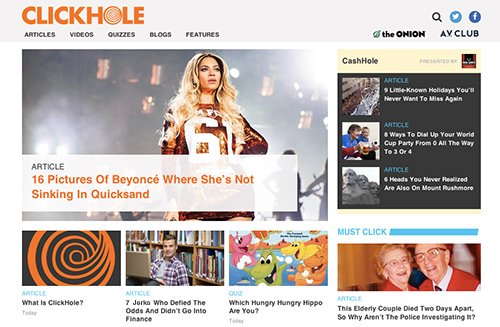 |
Clickhole, a spinoff website of The Onion, does a good job satirizing effective headline techniques. |
Generating multiple ideas and revising them over and over is an important part of writing all short copy, but you'll notice the need for this when writing headlines, headings, and subheads particularly, as they generally interact with one another in a puzzle-piece type of way, and so must be revised accordingly.
You may notice that in this course, headings and subheadings use parallel structure to delineate what a heading is compared to a subheading. The headings "Where You Might Find Short copy" and "Types and Techniques of Short Copy" both end with the term "Short Copy", whereas the subheadings under "Types and Techniques of Short Copy" all designate copy types, similar to how the "Cotton Monster" brand name produces categories or types that evolve from the name.
Parallel structure (AKA parallelism) is thus an important part of integrating headlines or headings with subheadings, but it's only one of the skills essential for producing this kind of copy.
Other techniques that will help you make headlines, headings, and subheads particularly effective include using descriptive, action-oriented verbs and active language. We'll take a look at these skills more closely when looking at other examples of short copy, but note that even when working with longer ad copy, opportunities abound for utilizing the skills that short copy demands.
Organization or company newsletters, brochures for products and services, prospectuses, annual reports, and other multi-page forms of advertising all need information to be organized by shorter and more succinct headlines, headings, and subheads. At first sight of longer copy, a reader will glance over the material to determine whether he wants to read it, and these short copy blips that summarize and organize content will either entice or turn away.
For fun, try the random Upworthy headline generator and see what you can deduce about the way it makes headlines through spoofing Upworthy copywriting techniques.
Taglines and Slogans
Taglines and slogans are my favorite type of short copy to write. They can offer a little more leeway for describing a brand, product, or service, and for imparting a feeling to the audience through tone and technique.
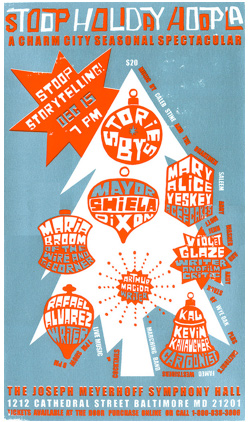
In the above ad for a storytelling series event called the "Stoop Holiday Hoopla", the expectation for what the event will consist of is depicted in the tagline, "A Charm City Seasonal Spectacular".
"Charm City"—a nickname for Baltimore, Maryland—works particularly well here in connection with the image. On its own, not only is the word "charm" a verb that denotes the act of charming, it carries a double meaning as a noun that's a type of ornament, like the ornaments on the ad image that display performers' names.
Altogether, the tagline offers a little more glitz and glam to the event name through its ornate and decorative feel, again playing off of the image by reflecting what it conveys. This follows the guidelines reviewed in Lecture One about writing text that coheres with visuals. The tagline does all of the following:
 |
|
 |
| |
1) interprets the image
2) considers its aesthetics
3) considers emotional/psychological responses to the image
4) responds to, adds to, or captures the image with text
|
|
 |
|
 |
Another form of double meaning, called a double entendre, hinges on the audience's detection of slang as an additional layer of meaning besides the literal. The website ArtsVegas.com, which for seven years covered the arts scene in Las Vegas and used the tagline "Art, Culture, and Entertainment in Las Vegas. Rocking since 2009," made good use of this technique:
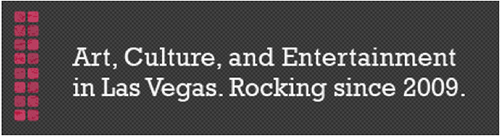 |
Rocking the double entendre. |
Though musical entertainment in Vegas literally can be rocking (as in playing rock music) and the website may have been, too, one of the slang meanings of "rocking"—of being animated, excited, and alive—speaks to an audience who finds excitement in attending arts and culture events, and who may even be "rocking" some great style at them.
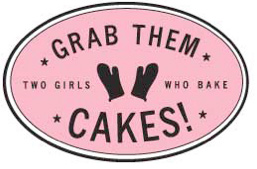
These kinds of plays on words are common in short text. The food business "Grab Them Cakes!" uses a tagline that offsets the sexual innuendo in its name, making itself more cutesy with the depiction of "Two Girls Who Bake."
The choice to use a rhyme in the tagline and play the sound of "bake" off of the sound of "cakes" also adds to the fun and lighthearted nature of the ad.
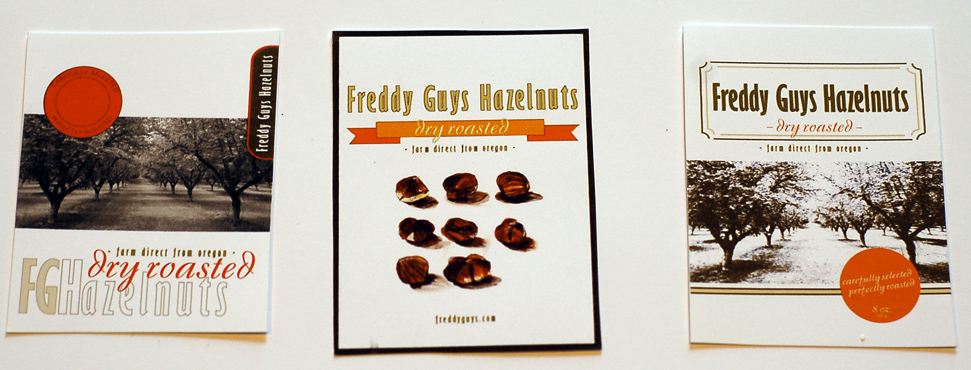
We can look at the following food product example for Freddy Guys Hazelnuts to see the stages in building an ad with a tagline as well as a slogan, and also see how we might distinguish these two types of copy.
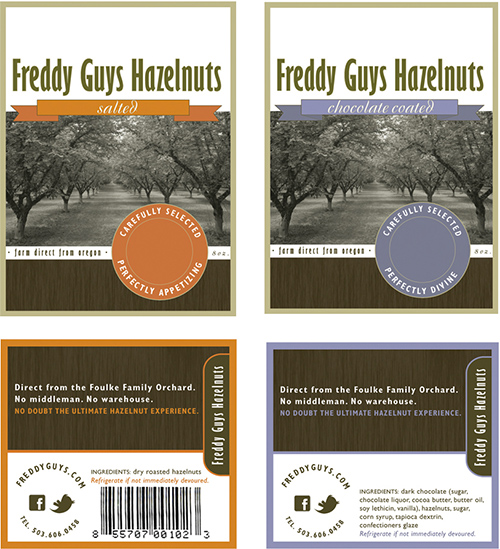
The first image below shows preliminary comps for a package design for the company's roasted hazelnuts. You can see how all three of the comps include the lowercase tagline "farm direct from oregon," but how the first and third designs also include a seal that reads "carefully selected" on the top and "perfectly roasted" on the bottom.
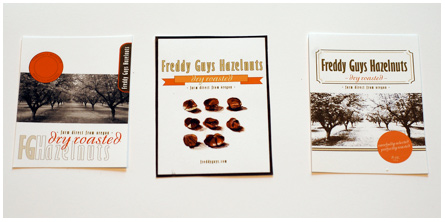 |
Carefully planned copy; designs by Ashley North Compton. Click the image to see it at a larger size. |
The final design for the product packaging, below, incorporates the tagline as well as the specific product slogan, and shows how the tagline is more of a permanent representation of the company, whereas the slogan stems from this particular branding effort.
You also can see how, while the dry roasted hazelnuts are deemed "perfectly roasted," other products in the same line are referred to as "perfectly appetizing" and "perfectly divine." The variation among the slogans uses the principle of parallelism, as we reviewed earlier, for consistency as well as catchiness.
It may not always be easy to distinguish between slogans and taglines, and certainly even seasoned copywriters and ad designers would be hard-pressed to do so, as the style that characterizes them is virtually the same.
For example, the California milk industry's well-known "Got Milk?" slogan may seem like a clear slogan for an ad campaign, but British Airways' "The World's Favourite Airline" may read as either a slogan or a tagline. Take a look at the AdSlogans Advertising Slogan Hall of Fame to see if you think there are distinguishing features to what makes those selected good ad slogans (or taglines, as they may be).
Also, this jokey Advertising Slogan Generator lets you input any word in order to create an irreverent slogan. (Be warned that it uses well-known slogans and drops other words into them, so it is only for a laugh, and definitely not a tool to use for writing real slogans!)
Captions
Captions are an interesting type of copy, as they make apparent the need to clarify facets of an image using text.
In copywriting for ad design, captions may be needed for many reasons: to accompany images placed in brochures, in multi-page ads that read like newspaper or magazine content, in one-page ads that incorporate images in a magazine-type layout, or in online ads that incorporate images like in a magazine.
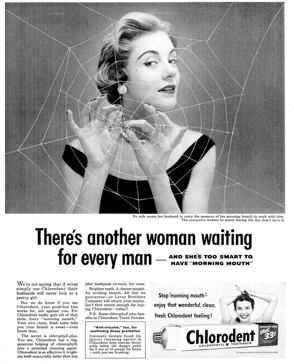 |
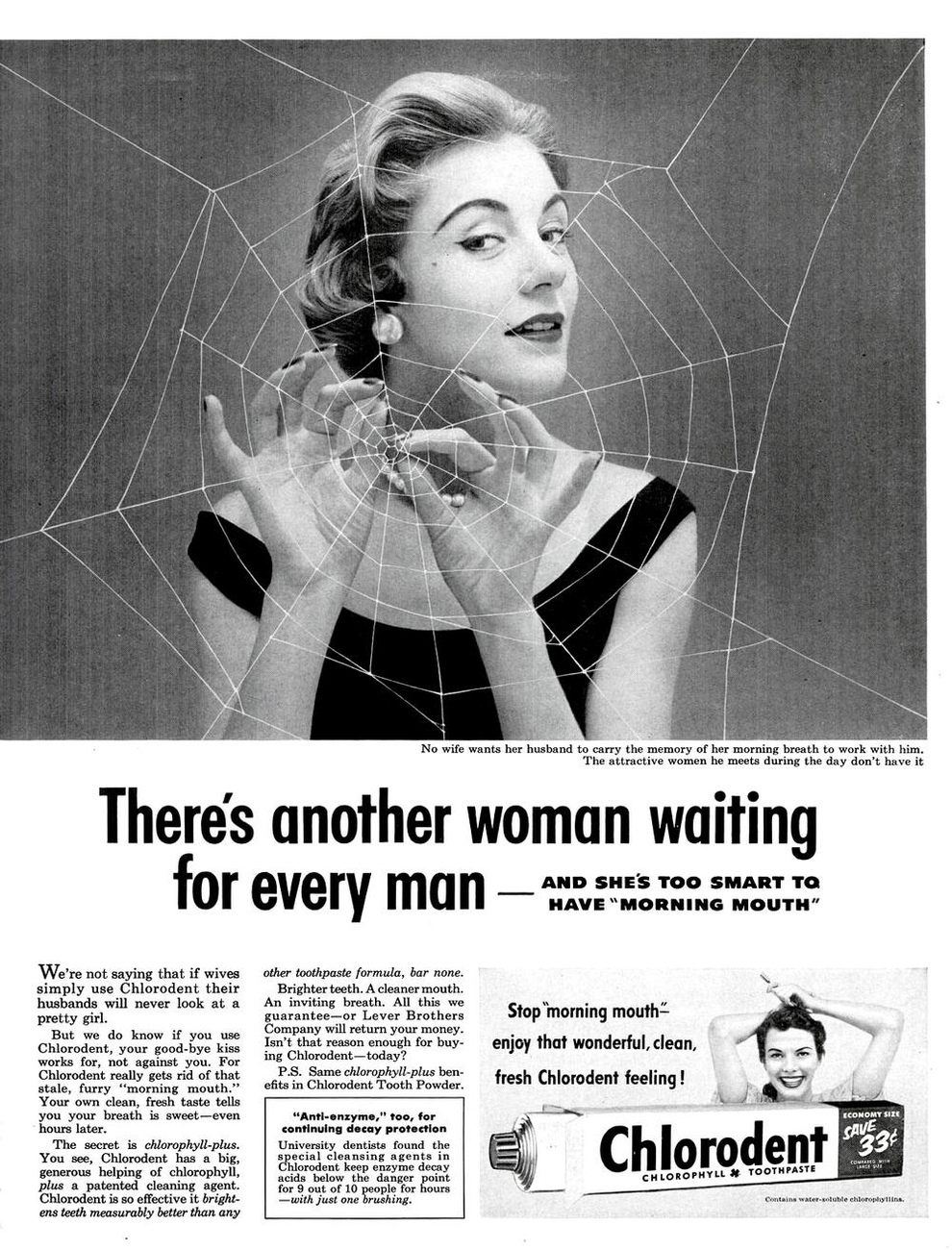
Capturing captioning! Click the image to see it at a larger size. |
In the vintage ad above, the idea in the text used as a caption is rephrased as title text. The caption carries a different tone, that I would say is more intimate.
Though "No wife wants her husband to carry the memory of her morning breath to work with him. The attractive women he meets during the day don't have it" is quite a long caption and not as effective or concise as it could be as short copy, it elaborates on the image in a way that clarifies its purpose.
Like taglines and slogans, captions can serve to convey mood and can add humor, reflectiveness, terror, or other emotions to the ad.
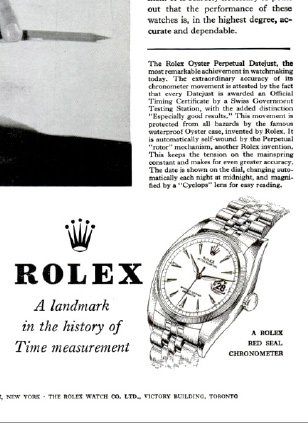 |
A caption can help identify the product more clearly. |
In the above Rolex watch ad, the caption "A Rolex Red Seal Chronometer" serves more clearly as an identifier for the image that it's next to.
You might see this type of caption more frequently, such as in cosmetics ads that identify the shade of makeup the model wears, or in clothing ads that identify the clothing style. These captions tend to be more direct and simply state what is shown in the image.
Among these two examples, you'll notice, as well, that captions written in complete sentences take normal sentence punctuation, but those that are not don't use periods.
In all, writing captions is a great ways to hone skills in being concise, direct, and conveying mood. Although the images aren't advertisements, take a stab at the weekly New Yorker Cartoon Caption Contest for some practice in writing clear, humorous captions. You can also vote on the top three prior week's captions to see caption ideas from other readers.
Tweets and Statuses
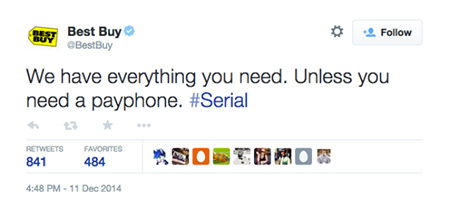
With the rise of social media advertising, ads that use text alone or in connection with single images are more and more common, especially as part of larger ad campaigns that aim to cover all of the bases with print, TV/radio, and online venues.
Developing a Twitter hashtag that will catch on and go viral—or even just a decent single tweet—requires insight into what the audience will respond to, as well as integration with other ad formats, for maximum cross-ad exposure and memorability.
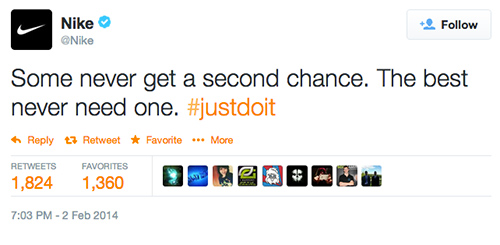 |
For iconic brands like Nike, the challenge of Twitter has been how to adapt their traditional tones and slogans to a new format. This debut tweet shows them effectively accomplishing this goal! |
The Twitter blog has a great graphic that gives advice on selecting and promoting hashtags, emphasizing that finding a hashtag that will have longevity takes more forethought than finding one for a single campaign or promotion.
Aside from hashtags, coming up with content for tweets themselves is similar to developing content for Facebook posts.
Using Facebook status updates as an advertising technique can mean various things, from promoting events, to sharing information that an audience will find interesting, to directly promoting the benefits of a product or brand. A blog called Nourished Kitchen often uses its Facebook statuses to drive traffic back to its website, through posts that highlight content on its site.
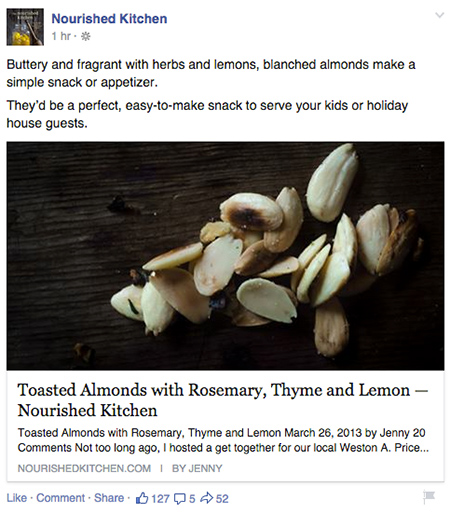 |
Descriptive and inviting, Nourished Kitchen's Facebook posts do a great job initiating conversation and directing viewers back to their site. |
Their posts follow a particular style convention that uses action verbs like "see" to direct the audience to action.
Consider post sentences like these:
|
|
|
| |
- "It's always a bit controversial, but agave nectar is in the spotlight again. See what I say about it here ---->"
- "Traditional bone broth is one of the cornerstones of real food, and it's ridiculously good for you. See how to make it here ---->"
- "If you have never tried a sourdough pie crust, you must! See my red currant pie recipe here ---->"
|
|
|
|
|
These sentences first entice the audience and/or peak their curiosity, and second, direct them to click a link. Though their posts are simple and direct, they also sometimes contain highly descriptive verbs, such as "whip" in "See how to whip it up here" and "throw" in "Throw your name in the hat here." You can tell how in this way, short, simple, and clear writing can also be distinct.
Short Ad Copy
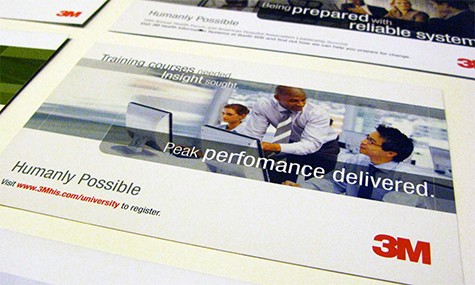
Sometimes ad copy is also just short copy that may not fall into the above categories. The phrases on the postcard below register neither as titles nor as another format. They do employ parallel structure by each presenting a one- or two-word noun followed by a verb: "Training courses" + "needed"; "Insight" + "sought"; "Peak performance" + "delivered."
In the examples shown in the next image, additional postcards in the ad campaign use questions to connect with the audience. They also use descriptive verbs such as "eliminate," "reduce," "saving," and "decreasing" in order to convey a stronger and more succinct message.
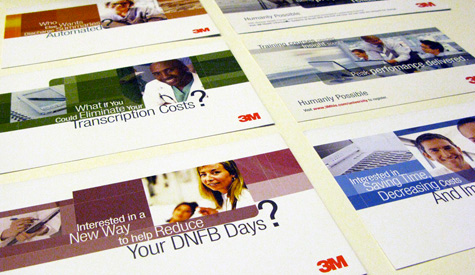 |
Eliminate lazy verbs and replace them with descriptive ones; designs by David Hardy. |



 Explore examples of short copy in different genres and forms.